

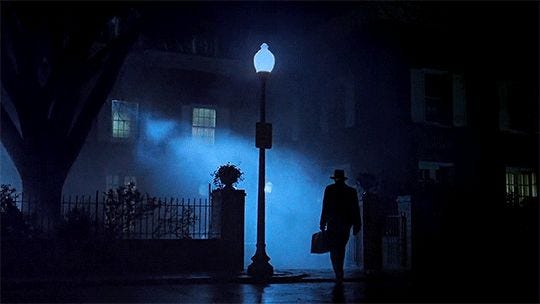
Recently, popular conservative podcaster Allie Beth Stuckey stirred up a lot of controversy with the proposition that Christians should avoid horror movies. This was really a side take in the middle of longer reflections on how Christians can “redeem” Halloween in general, but that side take quickly went viral and launched a thousand passionate response tweets. In brief, Stuckey’s argument was that the Bible is filled with injunctions to “fear not,” “be anxious for nothing,” etc., and yet here exists an entire genre specifically designed to induce fear in the consumer. It logically follows that Christians should be advised not to consume it. Jesus tells us not to be scared, so why are we watching things that make us scared?
Stuckey would later attempt to clarify what she was and wasn’t saying in this aside. She was not saying Christians should stay sheltered in the land of Precious Moments figures and Hallmark movies. She was not saying we should “close our eyes and ears to evil” or never read Dostoevsky. She doesn’t have a vendetta against all art depicting the battle between good and evil in frightening/suspenseful ways. She would simply like to suggest that Christians “shouldn’t revel in fear and horror” and that “maybe watching all five Final Destination movies every Halloween isn’t great for your mind, heart, and soul.” But none of that clarification mattered, because the Internet was going nuts as the Internet does, much like it goes nuts every Christmas when someone proposes it might not be a great idea to convince your kids Santa Claus is real.
The debate quickly took on a gendered flavor, as women in Stuckey’s audience came to her defense while men rolled their eyes and huffed at the weaker sex. One guy who’s constantly riding a hobbyhorse about bad Christian movies pointed at her take as an example of why Christian movies are bad, because women like Stuckey make up the “female demographic” that primarily buys them. Matt Walsh stuck his oar in too, admitting that some horror is trash but also offering familiar defenses of it as overall the “most Christian” genre. He also went webbing out into a broader lament about how modern Christians have generally lost their storytelling mojo, no longer able to tell “difficult, complicated, sometimes bleak and violent stories.”
Now, I am not really the target audience for Allie Beth Stuckey’s podcast. Allie Beth Stuckey’s target audience is very sweet, normie church ladies. I am not a very sweet, normie church lady, for those just tuning in. I am, in fact, something of a connoisseur of those “difficult, complicated, sometimes bleak and violent stories” that Matt Walsh claims modern Christians can no longer appreciate or create. (Although I’ve been known to anger Flannery O’Connor stans with my contrarian dislike of her work.) This very month, no less, I’ve been Zoom-workshopping my own such story with a theatrical company in London (a great experience, reflections on that coming later). And while I see the merit in Stuckey’s argument, I think there’s a place for scary stories—stories that “give you the shivers,” to quote one of Arnold Lobel’s Frog and Toad tales. One of my all-time favorite fantasy novels is a little forgotten one-off gem called The Face in the Frost, by John Bellairs, which contains some of the most deliciously terrifying, believable nightmares you will ever read. All that being said, in all the back-and-forthing, I have found myself (more or less, with some nuancing and caveating) on Team Stuckey.
Someone else who knows something about reading and writing such stories is crime-writer-turned-pundit Andrew Klavan. Indeed, Klavan’s appetite for these things significantly exceeds mine. Which made it all the more surprising when he too came out to declare himself (more or less, with some nuancing and caveating) on Team Stuckey.
