

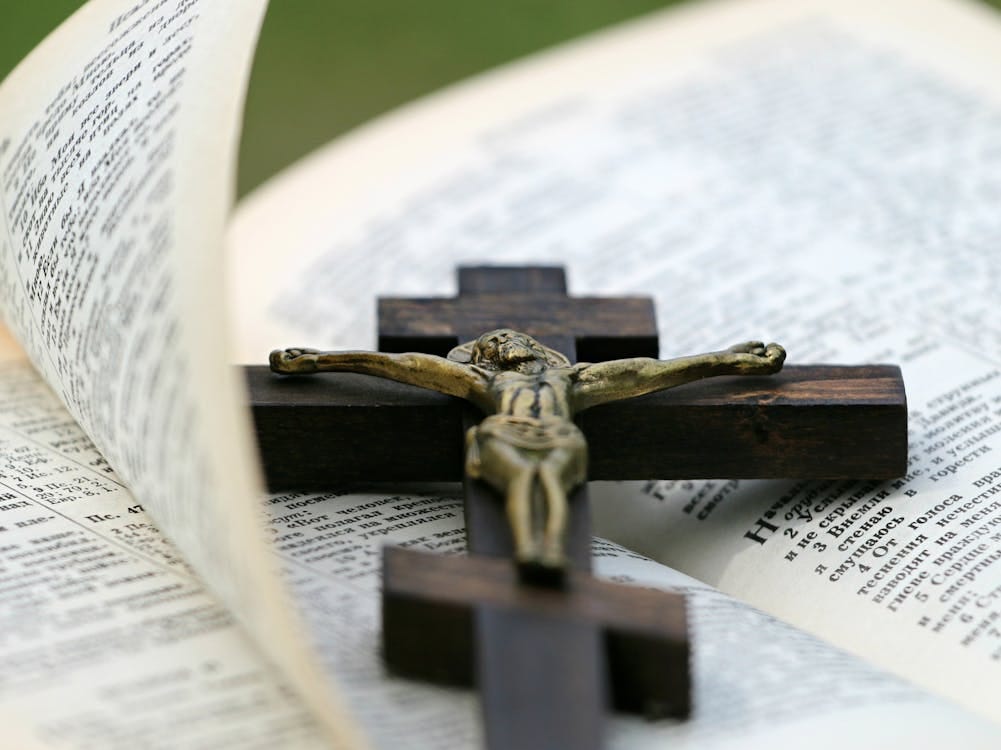
The Catholic journalist Julia Yost wrote an interesting piece recently about Catholicism among “the TikTok generation.” She is cautious not to strike a triumphalist tone about a “revival” that doesn’t exist, admitting that Catholicism is still losing a dozen deconverts for every convert it gains. Still, she notes that this Easter saw an uptick in converts who are skewing disproportionately young, and she observes the emergence of a Catholic subculture among urban young professionals. What could explain this?
She proposes that there’s the beginning of an answer in how different manifestations of Christianity pair with different stages in the evolution of online culture. In the Age of the Blog, we saw the rise of the Young, Restless and Reformed, because Reformed Protestantism inherently lent itself to long, verbally dense arguments. And Protestantism in general heavily emphasizes the Word. But in a postliterate Internet where Image trumps Word, Catholicism has the edge:
Protestantism, which began as a revolution against idolatry — the whitewashing of church interiors, the stripping of altars — has image-aversion in its DNA. The visual language of American Protestantism is accordingly limited. White steeples, Puritan clothing, snake handling: not much for an influencer to work with. Catholicism has icons and incense; rosaries, chapel veils and ashes; priestly black, cardinal red and papal white. … An old stereotype has it that Protestantism is for people who read books, and Catholicism is for people who want spectacle. Say hello to Gen Z.
There’s an awful lot going on here. I don’t think Yost is on to nothing, but I suspect she might be overselling the “trending” status of Catholicism. I clicked through to one of the Instagram pages she linked where some account was hyping Catholic clerical “drip.” What I found was a wall of chatbot text. Not a terribly aesthetic pitch, if you ask me.
Meanwhile, I also believe Yost short sells the resources of Protestantism. However, a proper discussion of this will require us to establish what we’re talking about when we talk about Protestantism. For any newcomers who don’t know my own background, I grew up in the Anglo-Catholic Church, which began life as a tiny conservative offshoot of the Episcopalian church. This meant that I was exposed early and often to the aesthetics of Anglicanism—with a Catholic twist, but the Catholic twists always felt optional. The Anglican aesthetic was very much its own well-defined thing. At the same time, I understood evangelicalism fairly well, since that was the tradition my parents came out of and since that was where we built most of our local community (because elderly Episcopalian refugees don’t really “do” community). And theologically, I retained a few lower Protestant distinctives.
The upshot is that I have always felt like I have one foot there, one foot in the magisterial Protestant tradition. I’ve jokingly called myself everything from a bad Anglican to a “high-Church Baptist.” I still think the Baptists have it right on some things, yet I’ve found it difficult to enter fully into the spirit of the service when I visit a Baptist church, because I feel no sense of separation between what’s happening on my side of the sanctuary and what’s happening at the front. With no altar, no sacrament, no sense that something different is going on up there, I feel rather adrift. The “stage” could just as well be the platform for a conference speaker.
Given all this, naturally I feel uniquely qualified to chime in on these interdenominational discourses.
I’ll start with where I agree with Yost. She is right to detect an “iconographic allergy” in at least some strains of Protestantism. To begin with, there is the fact that some denominations outright forbid any artistic depictions of Christ, believing they violate the Second Commandment about “graven images.” Obviously, this doesn’t affect all evangelicals, though one might wish it affected more of them given how much “Jesus kitsch” they can create. (Then again, it’s not as if Catholics don’t have their own “kitsch” market, as I’m sure many of my Catholic friends could wax eloquent about!)
My parents’ roots are Baptist, and though Baptists aren’t specifically bound by Second Commandment concerns, they do look askance at iconography, pomp and ceremony, ritual vestments, and so on. My mother remembers how displeased my grandmother was when a cross was added to the top of her church, and the addition wasn’t put to a vote. There was no doubt where her vote would have gone if it had been.
Now granted, that’s a little on the extreme side even for Baptists, who tend to be pretty okay with crosses. Not crucifixes though, because they want to avoid any hint of a suggestion that we’re worshiping the statue of Jesus on the cross. In my Baptist hymnal, there’s a line in “Abide With Me” that runs “Hold thou thy Word before my dying eyes.” But this was not the original line. Initially, it read, “Hold thou thy cross before my dying eyes.” It’s clear that whoever compiled this hymnal was uncomfortable with the iconographic nature of such a line. (Of course, this change hurts rather than helps the lyric. It doesn’t make particular sense to hold up a Bible in front of someone who’s dying, whereas the use of a cross or a crucifix in this way has logical precedent.)
The evangelical preference for Word over Image also works itself out in Protestant vs. Catholic filmmaking. Evangelical movies are famously bad, although there’s no inherent reason why a film with an evangelical Protestant aesthetic has to be bad. Robert Duvall’s The Apostle is a brilliant slice of southern Pentecostal subculture. However, it’s worth noting that the power of that film still rests on the titular “apostle’s” preaching voice—on his Word. It works because of Duvall’s incredible force of personality as an actor, and because he took the time as a writer to immerse himself in that subculture so that he could authentically represent it. But it wasn’t an easy feat, and sadly, evangelical filmmaking in general falls woefully short of Duvall’s craftsmanship.
A salient feature of some bad evangelical movies is the clunky reliance on a verbal “emblem” — some written monument representing the characters’ commitment to family and faith. These could range from a marriage manual to a set of resolutions to a closet full of prayer requests. The movie God’s Not Dead featured an inverted variation on this idea, as the cartoonish atheist professor tries to bully his students into signing a paper that says “God is dead.” In the spirit of these “emblems,” these movies were always very wordy. They didn’t understand the grammar of visual storytelling. When they did occasionally try to evoke visual symbolism, they rushed in to pile words on top of it. In one of these productions, the areligious protagonist goes for a Significant Walk and Talk with his Christian father where he vents about his marital woes. At a certain point they happen upon a very conveniently placed cross, which hovers over the father’s heartwarming mini-sermon about the gospel and unconditional love. Whatever visual power it could have provided is thus completely diluted by Words.
One curious semi-exception was a little film called Do You Believe?, which was more or less a Christian knock-off of Crash. The film opens with a pastor distributing a collection of small wooden crosses to his congregation. These take on progressively more symbolic meaning as they are passed along to different people the congregants encounter. In the film’s most affecting scene, a fireman gives his cross to a dying man, closing his hand around it while sharing the gospel—again, the need to supplement Icon with Word, but it was a poignant little moment, and in its way, a bit Catholic-coded. A minor Catholic novelist named Michael O’Brien used a similar motif in one of his books, except with small icons of the Virgin Mary. A saintly street woman passes them out, and they find their way to different characters in crisis. Do You Believe? was the only evangelical film I noticed playing with something like this. It was still pretty bad, but it was surprisingly buoyed in several key moments by the visual resonance an image can provide where dialogue fails.
Of course, those crosses weren’t presented as something to be prayed to, or as objects that could exert some miraculous power in and of themselves. But I imagine my grandmother would still have been uncomfortable at the way the fireman says “Here, take this” in that scene, pressing the cross into the dying man’s palm. “What does this little piece of wood matter?” she might say. It doesn’t “save” anyone, after all. The fireman’s verbal presentation of the gospel should be enough for that.
This hovers on the edge of a much wider, deeper conversation about tangible “vehicles of grace” in general. What exactly is the Communion bread, the Communion wine? The Baptists have their view, the Catholics have theirs. However, there is a range of views in between.
Which brings me to what strikes me as the biggest gap in Yost’s analysis: She overlooks the contributions of the magisterial Protestants, who retain a theological framework distinct from Catholicism without rejecting the liturgical, sacramental aesthetic. Over Passion/Easter weekend this month, I was graciously hosted in Hillsdale and attended the full marathon of services at Holy Trinity Anglican Parish for Good Friday, Holy Saturday, and Easter Sunday. They used the 1928 Book of Common Prayer, which brought back shades of my youth in my tiny old ACC church. There was a choir, there was incense, there was a large crucifix carried in and out by altar boys, and yes, for the yooth out there, the priest and all his acolytes’ “drip” game was strong.
If you’re thinking “Wait a minute, did you make me read all this way only to wrap up with a sales pitch for Anglicanism?” … yes, yes, that’s exactly what I’ve done. But in all seriousness, I think Anglicanism does make a strong case for itself as the ideal blend of Image and Word. None of the visual resonance of crucifixes, vestments, and so on has been chucked out. At the same time, the old liturgy offers religion of the Word at its very best, though my sales pitch is less enthusiastic for later versions of the Prayerbook that have watered the language down with modernizing tweaks. However, Anglicanism has an advantage over Catholicism in that its liturgy was partly translated from Latin, partly composed fresh when the English language was at peak elegance. Catholicism only switched to English when the language was in decline. So, while not all Anglican churches have resisted the late modernist tug, there at least is a better option available. And, encouragingly, parishes like Holy Trinity are home to many families who are training their children’s ears to love it. When I was telling my story at the dinner table and said it felt strange to be a millennial who “grew up Anglican,” my friend nodded at his two baby nieces and said, “Well, that’s going to be their story now.”
To all this, Yost might reply, perhaps fairly, that her purpose is to focus on broad cultural trends within the American religious landscape. For all that a tradition like Anglicanism can offer, it can hardly be said to be “broad.” The vast majority of serious American Christians will sort themselves out under much bigger tents. Of course, time was that most American Protestants attended mainline churches, which were famously not lacking in aesthetic pomp, but these have lost relevance as their gatekeepers slowly die without replacement. The revitalized Anglicanism I experienced at Holy Trinity is a picking up and carrying forward of the aesthetic riches those mainline gatekeepers failed to steward by their theological negligence. There is an audience for that particular combination, but for now, and perhaps for always, it will remain modest by comparison with the twin pillars of Catholicism and lower Protestant evangelicalism. (There are also question marks around the precise shape of Anglicanism’s future as old debates around questions like women’s ordination are made new again, with different dioceses falling on different sides. But that’s a topic for another time.)
For now, all I can say is that there is a way to accept and participate in the best of these “two Christianities,” Christianity of the Image and of the Word. There is a way to acknowledge that faith comes by hearing and seeing. It may be true that in a postliterate age the eye is more quickly caught by an Image, and the Image to be sure has its place. But there remains no substitute for the grounding of the Word. When one is elevated over the other, something will always be missing.
You make a great case for keeping both word and icon. I'm all for it, while recognizing that one or the other may tug more at the heart at any given time. That's fine too. I'd love to see you write a piece about inherited words versus personally generated words, and how that plays across American or just post enlightenment religion.
Thank you for your thoughts and perspective. I was Southern Baptist for most of my "saved" life. But something was missing. I thought it was what I called "High Church" (thinking the quiet reverence in the sanctuary & reverent ceremony of the Catholic worship service). In my early 60s and as a recent widower, eHarmony happened. This led me to her (more formal) PCA church. WOW! Turns out I actually longed for more depth; depth in the WORD (doctrine & theology versus "Bible prescription" lessons in SS). Our PCA pastor's wedding gift was a copy of "The Valley of Vision" (Puritan devotions & prayers). After 15 years, we still read one of these in our morning devotions together; none seems "old," even when we've read it for the umpteenth time. They had a special gift with words. I carry some of their phrases in my mind, such as "Thy rod perfectly fitted to my back."