

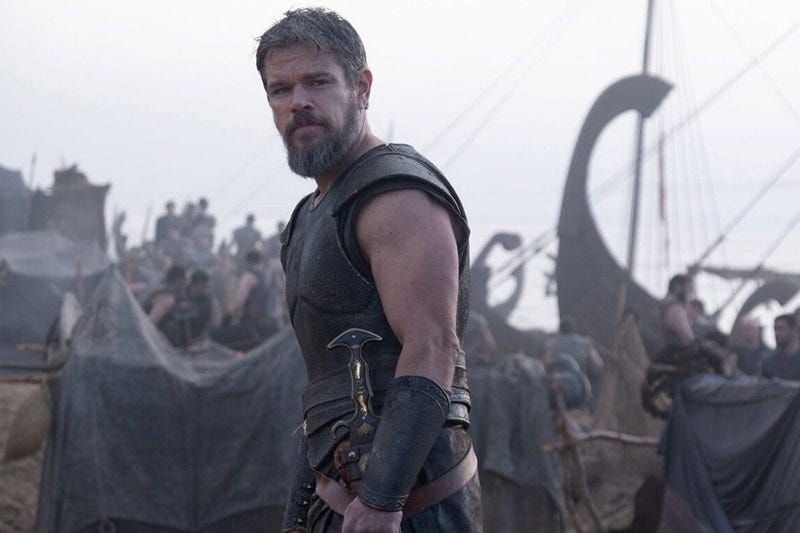
All reviews of Christopher Nolan’s The Odyssey should begin with the recognition that the poem may be great, but in its original shape it is unfilmable. The most faithful English-language stab at doing so—Andrei Konchalovsky’s 1997 miniseries—is three hours of pure camp. Hermes hovers about in what looks like a golden diaper, delivering his lines in a manner that would make you think he’s light in his loafers if he had any loafers. Poseidon speaks from the waves with a literal face sculpted from the stuff of your worst 90s CGI nightmares. Isabella Rossellini’s Athena chews up the scenery with Armand Assante’s Odysseus, blushing and gushing over our hero’s clever ways and general hotness. Of course, that’s exactly what she does in the book.
This presents a conundrum for the contemporary filmmaker who’s always wanted to put his own stamp on the great work, yet aspires to seriousness. It’s a particular conundrum for the man who made the Dark Knight trilogy. At moments, The Odyssey resembles nothing so much as a Marvel movie, but DC is the only language Christopher Nolan speaks.
But like its hero, the poem is polytropos—a work of many twists and turns, and many moods. It is comedy one moment and tragedy the next. It can be read as a child’s fantasy adventure or an ancient allegory for the random horrors of war. It has been riffed on by everyone from Kenneth Grahame to James Joyce. It’s too postmodern to say the poem can be whatever you want it to be, but one can see why Nolan might have been tempted to think so. Though what precisely Nolan did want it to be remains a bit of a muddle, right from his ambiguous title card: “In a time of apparent magic…” Lots of weird spooky stuff happens, but are the gods real? Nolan’s Odysseus apparently has the same question.
In Nolan’s defense, he isn’t the first to keep Homer’s cartoonishly divine intrusions off-screen while feeding his hero gruff proto-atheist one-liners. Kirk Douglas’s 1954 Italian-American version was a forerunner in that regard, albeit one that took itself far less seriously. (That production is worth watching just for the fun of seeing an Odyssey that feels like a 2-hour Star Trek episode, complete with “Who among us hasn’t bedded the occasional sea witch/alien babe?” energy—though even Douglas’s roguish Odysseus is chastened in the righteously angry presence of his faithful Penelope, cleverly played by the same actress who plays Circe. Interestingly, that version also suggests that Odysseus’s series of unfortunate events is a curse for Troy’s sack, even featuring a scene in which Cassandra bawls him out.)
Nolan’s most visible hint that the gods might be real is a radically reimagined Athena, here showing up as Odysseus’s scowling guilty conscience rather than President of the Odysseus Fan Club. Not that I’m saying it would have worked cinematically to give the President of the Odysseus Fan Club a prominent role. But better to cut Athena altogether than have her drop in for the occasional dour lecture and ominous headshake. Particularly since there doesn’t even seem to be a consistent narrative of what Odysseus needs to be sorry for.
[Here follow movie spoilers, if anyone cares.]
The already much-dissected third-act twist firmly establishes the Trojan horse as his nuclear bomb, the unforgivable sin that has shattered “Zeus’s Law” of hospitality forever and reframes the whole journey as a cosmic mirror of his own lawbreaking. (Though flashbacks show him improbably stumbling about Troy dazed and confused, as if he’s shocked, shocked to find sacking going on in this establishment.) At the same time, Schoolmarm Athena has spent the last two hours scolding him for beating himself up too much over his lost men. Apparently, he needs to stop being such a modern American officer about all this and trying to “assume responsibility” for their fates, when the gods already had a committee meeting to which he was not invited.
That cold pearl of wisdom is in fact rather in the detached spirit of the source material, which for all Odysseus’s leadership failures seems at pains to exonerate him (to the dismay of veteran psychiatrist Jonathan Shay in his book Odysseus in America, which like Achilles in Vietnam develops some intriguing if sometimes unconvincing metaphors between the work and his clinical research). But this then clashes very oddly with Nolan’s climactic reveal that quite literally everything has in fact been Odysseus’s fault this whole time, complete with the reveal that (last spoiler warning) a beheaded priestess looked like Athena in disguise. Does this mean she’s been a PTSD vision all along? At this point in the plot, anything goes.
This is a film struggling mightily to decide what genre it wants to be when it grows up—an understandable struggle, given the source material, but for all Nolan’s aspirations to Cinema, the whole rickety affair still comes off more like the unsuccessful sort of 90s fantasy movie. Tired defenses of the dire script like “What, should they all have spoken ancient Greek?” or “Well Homer would have sounded casual for his time” are as unconvincing as all such defenses of such things. There is an art to writing dialogue that is at once engaging and suited to the register of epic source material. It requires an ear for what is graceful and what is clunky, which Christopher Nolan, bless his heart, has never had. Meanwhile, the whole enterprise is too self-serious to even shoot for the hat trick that made a film like The Princess Bride magically work. But I do give props to Robert Pattinson as slimy Antinous, who simply decided he was going to Prince Humperdinck his way through it and then committed. His instantly memeable “Somebody get these BEGGARS out of here!” will probably have a longer shelf life than the movie. And Matt Damon does manage to find a couple moments for himself, as when he discovers his men fatefully roasting the Sun God’s cattle and snarks in pure Bostonian, “Did ya think if ya ate quietly, the Sun God wouldn’t notice?”
Homer’s Odysseus might be described as, if not slimy, at least rather slippery. And in a few moments more than that, like the pirate raid on poor Ismarus where he matter-of-factly divvies up the women among his men, or the brutal torture of his turncoat goatherd, or the hanging of the disloyal servant girls (though they arguably deserved it, but we don’t have to go there). This is another much-discussed conundrum for Nolan: No adapted Odysseus can be too Greek if the contemporary filmmaker wants to keep a contemporary audience.
But at least some of that roguish, polytropos quality—à la likable scoundrels such as Iron Man or Jack Sparrow or Han Solo—would have put color back into the character, who in Nolan’s typically asexual rendering doesn’t even flirt with sea witches, let alone have relations with them. Kirk Douglas’s Odysseus is another story, a product of an era more forgiving of adulterous men, as well as an era in which it wasn’t yet un-PC to portray women as dangerous seductresses. But it’s no longer au courant for a Helen of Troy to be the kind of woman who might have gotten a thrill out of men going to war over her. Nolan has reimagined her as a suffering victim, her famous face a mere excuse for the men to go to war over trade routes (and, it’s implied, scarred by a thuggish Menelaus).
It’s likewise not au courant for Circe to turn men into pigs just for kicks and giggles. She must now be burdened with the psychological baggage of a rape-traumatized feminist—too quick to judge the poor saps, but still a damaged vessel for the film’s morals about men, the universe, and everything. As for Calypso, who originally makes Odysseus her captive sexual plaything for seven years, she must be converted into an anxiously sympathetic Malibu babe who’s just keeping Odysseus on an alternative diet of lotus until he’s “ready” for his first therapy session. There’s no overt indication that they’ve slept together—the ethics of therapist-patient relationships on her island are left unclear.
By now you’ll have guessed where I fall on the already stale discourse about whether the movie is woke. With apologies to Jonathan Pageau and a few of my very online friends, I don’t think Nolan is playing 4D conservative chess with his casting choices. I believe it was distasteful for him to cast the visibly ill Ellen (“Elliot”) Page as a Greek soldier, thus perpetuating her delusion and persecution complex cycle, and I don’t think the fact that her character is supposed to be pathetically scrawny makes this better. Perhaps he was motivated less by politics and more by loyalty to actors from his “stable,” but it was badly done regardless. At the same time, I don’t think Nolan hates Western Civilization, etc. Gritty as Dunkirk was, it still emerged as a celebration of England’s old-fashioned heroic spirit. My read on Nolan is that he’s your rather basic British Gen X liberal chap: not an activist per se, but willing to doff his hat in the politically correct direction on the way to making his nerdy pet projects. One might call him “90s woke.” Hilariously, this hasn’t spared him from a scathing review by progressive feminist classicist Emily Wilson, who didn’t return the favor of his generous praise for her translation of the poem. The landscape of Christopher Nolan criticism is a horseshoe with Emily Wilson and Matt Walsh meeting at the two ends. Who knew?
It may not have impressed Emily Wilson, but I do sense an intentionality in Nolan’s choice to cast an Ellen Page or Lupita Nyong’o in the roles of heavily reimagined characters who are victimized by dominant men. Page’s Sinon, not in The Odyssey but in The Aeneid a trickster in his own right who persuades the Trojans to accept the horse, is now Antinous’s hapless brother. Sent to battle in the cowardly suitor’s place, told nothing about the trickery of the gift he innocently offers, he’s a duped sacrificial lamb whose slaughter haunts the movie from beginning to end. In beggar’s disguise, Odysseus takes on Sinon’s name and reverentially dubs him “the bravest young man I ever knew.” We get it, Nolan.
Where Nolan does get back to the actual text, he finds elements that play to his narrative strengths. He’s famous for non-linear narratives that play tricks of time and memory on the audience. In that respect at least, he’s well-suited to The Odyssey, finding impressively efficient ways to convey information through well-placed flashbacks in Homer’s spirit (yes, the dog is included). With all the comparisons to Oppenheimer, fewer have noted that the story shares DNA with Interstellar—not Nolan’s most tightly crafted but perhaps his most human work. He’s also endlessly fascinated with philosophical questions around free will and determinism and the extent to which our fates are written for us. This cashes out here in the form of a narrative that, while mostly keeping the gods in the shadows, effectively builds the creeping doom that hangs over Odysseus’s crew as Zeus’s “harsh hand” blots out the day of their return one by one—or six, as monstrous calamity may be. A scene where Odysseus looks back shell-shocked at floating bodies in a red sea may be too obviously trying to invoke Saving Private Ryan, but then it’s not like there’s no suggestion in the text of something like “survivor’s guilt.” Though the poem’s Mediterranean demonstrativeness—men freely weeping over their comrades—is here replaced with American stoicism.
There is also an economy about most of the horror sequences (Circe’s spell excepted, which takes an especially stomach-churning body horror form). The poem lingers at greater length than the film on Odysseus’s horror at the attack of Scylla, and his helplessness to save her poor doomed victims as they cry out to him. I actually approve of the scene’s brevity in Nolan’s rendering. Another reviewer observed that the monster almost literally looks like a six-fingered hand of fate, here in one horrible moment and gone the next. (Peter Jackson could never.) In keeping with this tone, the Cyclops sequence is much condensed and renders the giant as a pathetic, mostly non-verbal brute who doesn’t swap any droll “riddles in the dark” with Odysseus. This works as horror and as a chance for Odysseus to display physical courage when he rushes back through the closing cave mouth to be with men who couldn’t escape. But without the verbal banter, the “Nobody” joke, and then Odysseus’s disastrously hubristic parting shot where he reveals he is not in fact a Nobody, we once again lose multiple layers of his characterization—the wiliness, the rashness, the thirst for glory and an everlasting name. Having him instead shoot a literal parting shot with his bow simply isn’t the same.
It’s not that Matt Damon, star of The Talented Mr. Ripley, couldn’t play Odysseus the polytropos man of twists and turns. He’s simply not allowed to, beyond the occasional flash of dry humor or cheeky smile. One grin slips out just before the Siren sequence, as he explains that he just wants to see what will happen and live to talk about it. But we’re plunged back into agonized despair as their song tortures him unbearably. Cleverly, Nolan leaves the song to our imagination, placing us in the shoes of his deaf men. Scholars have argued over exactly what the passage in the poem means. It seems to suggest something beyond mere sexual seduction. Nolan’s Odysseus can only fumblingly describe it later as an unreachable itch, a reminder that “what you most want is what you most can’t have, and what you most can’t have is what you already had, and lost.”
In the end, as is typical with these things, what movie Odysseus wants involves far more angst and self-doubt than what poem Odysseus wants. Though in the spirit of Logan, which for all its Shane-like brooding about violence still allows the hero to have a proper good time spearing some proper baddies in the end, Nolan more or less understands the assignment of the revenge sequence. On Twitter, someone was snarking about what appears to be a leaked theater clip of the climactic moment when Odysseus reveals himself in the electrifying strum of his great bow. The theater audience erupts into cheers, which Brits and Europeans evidently find very cringe and “American.” Never mind that if you time-traveled a theater full of ancient Greeks into a cinema, they’d be yelling at the screen too. (Though no doubt yelling other things at the screen at other points.) There is also some cheer-worthy work from loyal Eumaeus, who remembers his old master as harsh “but fair, fair and worthy of following.”
And yet, there’s still a funereal quality about Odysseus’s march to meet his destiny. He remains, in a phrase essayist B. D. McClay has helpfully coined in the New York Times of all places, a “halfway-hero”: a man who’s not the Worst Guy Ever but screws up, has himself a crisis about screwing up, and then finally, grimly, does what has to be done in Act 3. We’ve lost the cultural grammar to properly appreciate masculine qualities like decisiveness, the yearning for heroic glory (fateful as this might be, which Homer also grapples with), or the desire to claim a rightful throne.
This brings me to what I consider the film’s most unforgivable sin. It is not merely that Odysseus is uncharacteristically guilt-ridden about the Horse. It is that in the end, as punishment for this sin, Nolan does not allow him to come home. Like a Clint Eastwood hero, his Odysseus is a man of violence past the point of no return to become a man of peace. So he will become a sin eater. He will refuse to let Telemachus join him in the slaughter, out of a decidedly un-Greek sense that the boy’s hands would be “stained” otherwise, and out of his practical plan to spare Telemachus from the wrath of the suitors’ families. If father and son both survive, the father will leave the kingdom in his son’s clean hands and impose the exile upon himself—along with Penelope, who does her best to spin the whole thing as the Best Forever Boomer Cruise Ever.
This is a jaw-dropping inversion of the poem’s central theme: resisting all the world’s seductions to finally end all your exploring where you started, and know it for the first time. It’s one thing for Tennyson to do a poetic “What if?” scenario in which his Odysseus spends three years trying to as it were reintegrate, but unlike Homer’s Odysseus finds the sea’s Siren song too alluring. But Tennyson is not claiming to reintroduce a barely literate generation to the poem known as The Odyssey. Further, he understands well that sailing away forever is a temptation, indeed Odysseus’s besetting temptation, and thus fully grasps the original poem’s theme.
Nolan seems to have Odysseus confused with a cowboy, inevitably cursed to wander without ceasing in the wilderness beyond the world he violently tamed for the men of peace. In fact, Odysseus is a man who must be chastened into being the man of peace, into laying down his burden to study war no more. He must give ear to the hard, hard saying of Achilles’ ghost in Hades, who laments that if only he hadn’t favored fleeting glory over a little life full of days, he would not be here. He must reach out in vain and cry for the ghost of his mother, dead with grief in his absence, slipping through his fingers. And when the goddess offers him immortality, he must find the strength to say no.
The Douglas Ulysses, though hardly a timeless classic, still grasped that theme. While in its own way it’s getting creative with the source material, this speech accomplishes in under 2 minutes what Nolan couldn’t (or wouldn’t) in 3 hours. Many lost ingredients are in the mix of a scene like this, not least that distinctly mid-century brand of full-throated, chest-out humanism:
Here someone might recall from the poem that Odysseus does still have to take a leave of absence from Ithaca to travel inland and make proper sacrifices to Poseidon. But then he gets to come home. There is a mechanism of atonement. Nolan’s reimagining, by laying all the guilt on Odysseus with no chance of redemption, is hardly the “Christian” reading everyone has dubbed it. It is more Buddhist than anything else, and thus in its own way merely another variation on the theme of paganism.
And still, for all of this, I will give Nolan some credit for doing the impossible: making a piece of monoculture in the year of our Lord 2026. As endless Discourse topics go, surely we could do worse than an ill-conceived blockbuster take on a foundational piece of the Western canon that has sent theatergoers flocking back to (and arguing over) the source material. I hadn’t picked up the work myself since college and am grateful to Nolan for inspiring my re-read. I chose the 1996 translation by Robert Fagles, which uses some contemporary idioms but to my ear successfully threads the needle of being casual without being graceless. Appropriately, I will close with his rendering of Odysseus and Penelope’s reunion:
The more she spoke, the more a deep desire for tears
welled up inside his breast—he wept as he held the wife
he loved, the soul of loyalty, in his arms at last.
Joy, warm as the joy that shipwrecked sailors feel
when they catch sight of land—Poseidon has struck
their well-rigged ship on the open sea with gale winds
and crushing walls of waves, and only a few escape, swimming,
struggling out of the frothing surf to reach the shore,
their bodies crusted with sault but buoyed up with joy
as they plant their feet on solid ground again,
spared a deadly fate. So joyous now to her
the sight of her husband, vivid in her gaze,
that her white arms, embracing his neck
would never for a moment let him go…
Dawn with her rose-red fingers might have shone
upon their tears, if with her glinting eyes
Athena had not thought of one more thing.
She held back the night, and night lingered long
at the western edge of the earth, while in the east
she reined in Dawn of the golden throne at Ocean’s banks,
commanding her not to yoke the winsdswift team that brings men light,
Blaze and Aurora, the young colts that race the Morning on.
Did you enjoy this post? Browse more of my movie takes here or literature takes here.
You are of course 100% right about everything. The Emily Wilson review is hilarious, as is Daniel Mendelsohn’s anti-Nolan ranting on X, as was The New Yorker’s admission that the movie is basically Homer for dummies.
I understand people who have polarized reactions to David Lynch or Bergman, or heck even modern r rated “classics” which I can’t abide (bring back the hays code!). But I have no idea how so many seemingly intelligent film critics can hail this as a masterpiece. You can say, ok, it’s not trash, but to go all in on its sheer genius? Do you have to be so consumed by hatred of Matt Walsh that you ruin your critical reputation? Or have people simply no exposure to good old movies so that anything today without Thanos in it seems a masterpiece in comparison?
Anyway, thanks for the great review!
Brilliant review.