

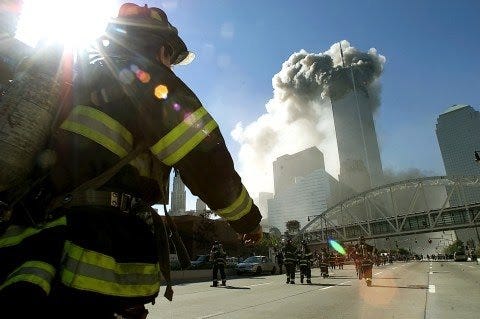
[By request, here is the talk I delivered at my small seminar reunion conference in Washington this month. I’d been spending a lot of time with primary and secondary sources on September 11 for the 25th anniversary, thinking about all the many ways there are to tell the story of that day. One article in particular by the classicist scholar Daniel Mendelsohn sparked a long train of reflection on the intersection of history, art, and myth, with special focus on the question, “Why is it so hard to make art, especially cinematic art, about September 11?” I’m so glad the opportunity presented itself for me to turn all that mulling into a presentation. This is a little more “meta” than I normally go with my commentary, even involving some interaction with bloody postmodernists, but as you’ll hopefully see, they didn’t turn me postmodernist in the process. The talk was well received and generated great discussion. I’ve lightly tweaked and polished the transcript, cleaned up some of my annoying filler tics, and added hyperlinks so people can go explore my references for themselves. Paid readers can enjoy the whole thing, free readers enjoy the free preview. Happy reading!]
Thank you, it’s great to be here. So when I was very vaguely pitching the idea of a 9/11 talk to Nathan [Pinkoski], I thought I could kind of get away with kind of rehashing something I already wrote in Compact. Some of you might have seen I had a little piece in there about remembering 9/11 in an age of unreality. It was basically about the in-breaking of 9/11 as a Real Event, capital R, capital E, and a kind of Real Event that we all experienced as a collective in a way we don't experience news anymore. So by “the age of unreality,” I was thinking about the digital age, the Internet age, and this very fragmented, kind of detached way that we now engage with the world and with news. But Nathan said nope, sorry, you can’t rehash, gotta do something new. So I’m doing something new. I’m going to sort of take a leaf from Slavoj Zizek, a little Baudrillard, and then just kind of do my own thing, so we’ll sort of see how that goes.
So Zizek wrote an essay in 2002, it was called “Welcome to the Desert of the Real,” which you might recognize as a Matrix quote, which was in turn quoting Baudrillard. And where Zizek goes with this is because “Human kind cannot bear very much reality” (thank you T.S. Eliot), the West was really struggling to integrate 9/11 as a Thing That Had Actually Happened. And so we kind of processed it almost like fantasy. So you could invert this idea of it being an in-breaking of the Real and think of it instead as an in-breaking of the fantastical, or even the mythic. There’s a great Onion headline from the first issue they ran after the attacks, “American Life Turns Into Bad Jerry Bruckheimer Movie,” in which there was a picture of the towers, and the caption said, “Above: An actual image from real life.” Which, you know, that was the mood, right? That kind of perfectly captured it, in a dark way. Here was this thing that all of our entertainment, all our movies, had fantasized about, and then we got what we wished for in some weird, perverse kind of way. The fantasy came true, and we couldn’t…it just didn’t compute.
A good illustration of this is an eyewitness account from Daniel Mendelsohn (he's a classicist, just came out with a new translation of The Odyssey). He was actually in New York on the day, and he witnessed the first plane hit Tower One. And he said when he first saw it, his very first thought was, “Well, they must be doing a movie, but why are they using real planes??” And then, of course, the penny dropped, and he calls his wife and he goes, “Turn on the TV, turn on the TV!” But of course, there was nothing for her to see on the TV yet, because it had literally just happened. And the way Mendelsohn puts this is, “What had just happened had not yet become the story of what happened.” And that’s a great way to kind of tee up my topic, because I’m interested in the story of what happened. Or, we could say the stories, plural, because there are many lenses of interpretation through which you can look at the event, many, many parables you could turn it into. So I’m going to think about a few of those.