

Well folks, another Oscars night has come and gone, and I couldn’t care less. Really, I couldn’t. I tried! Though as a certified cinephile, I don’t say this out of a generalized hatred for the movie business. Even in recent memory, there have been much stronger nominee slates. If you’d like a better 2025 sampler, I’ve unlocked this piece from back when the nominees were announced. A few nominated performances did make it into that list, but by and large, the Best Picture slate just didn’t do much for me. However, since I don’t write enough on movies hereabouts, I thought a few people might like a throwback look at five winners of the little statuette and why I think they particularly deserve a watch from Christians.
I should clarify, this isn’t the same as my top five list overall, i.e. “Best Pictures Every Human Being Should See.” That list would include things like The Sound of Music and Casablanca, which I’m just going to assume you all have seen, and if not…I try not to judge, but I will judge you a bit. Sorry. I was moved to reflect, though, that many of my all-time favorites have historically fallen in the “honor to be nominated” category, though some are much better remembered than whatever did win that year. It’s a Wonderful Life, for example, has endured long after The Best Years of Our Lives was forgotten, not that the latter was bad or unpopular in its day, just not immortal. Fiddler On the Roof lost to The French Connection. Many such cases. Somewhere around the late 60s, there was a turn where the awards criteria started to become progressively more nichey, though perhaps still sometimes awarding good work. Time was, the most popular films were also the most awarded were also objectively the best. That stopped being the case long ago.
At least one of my picks here is going to pull from that “not wildly popular but worthy” pool however, because I am still after all a critic, so I need to hold onto my card somehow. But what they all share in common is that they offer something to instruct, edify, or move the Christian viewer. Herewith: five best pictures every Christian should see.
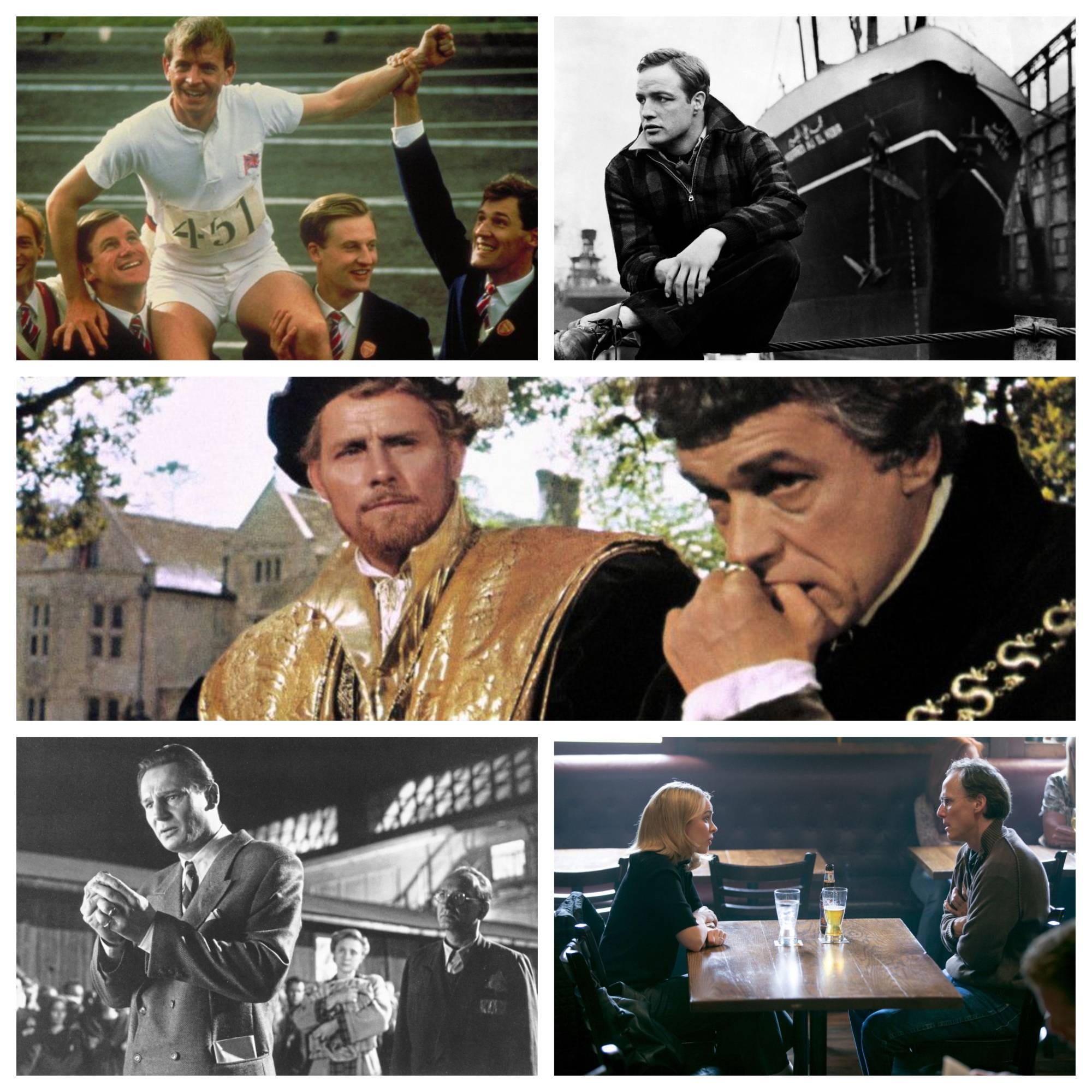
Chariots of Fire (1981)
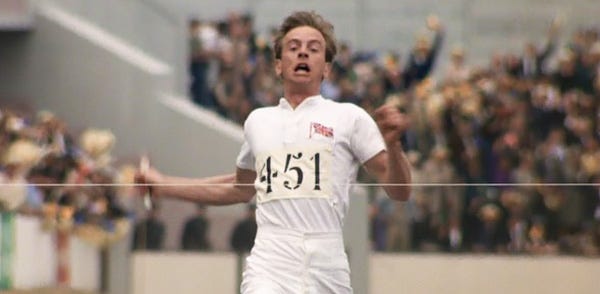
“But He also made me FAST. And when I run, I feel his pleasure.”
I’m not sure why, but aside from the score, people don’t talk much about this film. Even Andrew Klavan, in his new rapid-fire “rate the Best Pictures” series, gave it a B and moved on without much fanfare. And while evangelicals of my parents’ generation quoted it all the time, among younger Christians I get the sense that it’s falling out of familiarity. This is a real shame. So many things about the craft of this movie deserve close study: the casting, the writing, the cinematography, and of course the way all these things improbably mesh with that score. Perhaps it goes underrated because it’s relatively understated. Apart from a handful of explosive race scenes, it operates more as a quiet character study than a sports film. You really need to pay attention to pick up all the little touches that make scriptwriter Colin Welland’s dialogue so crisp, and occasionally so funny. (“That’s a matter for the committee,” says one pompous character at a crucial moment in the prolonged sequence where they’ve gathered to discuss Eric Liddell’s implacable Sabbatarianism. “We are the committee,” comes the irritated reply from a fellow peer.)
Among Christians, the film is chiefly remembered for Liddell’s famous line, “I believe God made me for a purpose. But He also made me fast. And when I run, I feel his pleasure.” So far as we know, the real Eric Liddell never said this, just like we don’t know that his father ever really said the complementary brilliant line, “You can praise God by peeling a spud if you peel it to perfection.” What the film accomplishes so movingly is to match the glory of this man’s life with a simple eloquence of language he never found for himself, while somehow never feeling overwrought or pretentious.
The rivalry between Liddell and the tortured young Jewish sprinter Harold Abrahams is not the conventional sort. In fact, they barely share any screentime, and by the third act they’re on the same team. Technically, Abrahams is the protagonist. We’re always in touch with his volcanic, sometimes childish emotions, and we observe the uncanny young “flying Scot” through his jealous, wondering eyes. In one sense, as I once saw a Jewish writer provocatively argue, you could say Liddell was more Jewish than Abrahams, with his willingness to sacrifice everything for the sake of the Law. (The real Abrahams didn’t keep the Sabbath and believed Jewish athletes shouldn’t have to.) But Liddell’s effortless gift also functions as an echo of the gospel, by contrast with Abrahams’ endless agonized striving. In Liddell’s moments of triumph, we watch Abrahams watch him from the sidelines, lost in uncomprehending awe.
Playing Liddell would catapult young Ian Charleson to breakout stardom and wealth. Like Liddell, Charleson also hailed from Edinburgh. But his own relationship with organized religion was, in producer David Puttnam’s words, “a bit haphazard.” A profligate bisexual, he would reap the same deadly harvest as so many young men of his generation. Less than ten years before his death, Chariots marked the peak of his film career. Though on paper he couldn’t have been more different from the man he played, he desperately wanted the role. Puttnam wrote about the “desultory” first lunch meeting where he and director Hugh Hudson tried to sound out the shy young actor. Charleson would only much later explain this was because he was so terrified of not getting the part, he could hardly say anything.
Once committed, Charleson gave the performance everything, even personally crafting Liddell’s sermon scene. When he asked for permission to do this, Colin Welland asked how well he knew the Bible. “I’ve almost finished it,” he said, on his first read through the “most closely annotated copy” Puttnam had ever seen. Hudson recalled that he was still working over the sermon scene up to an hour before filming, so when it was time to roll, he tucked it into a hat he held close to his chest, allowing himself an occasional smooth glance downward. As a child, of course I had no awareness whatsoever of this great poignant contrast between actor and character, but I often think about it now—a son of Scotland’s decadent post-Christian present, whole-heartedly reaching back to a son of its Christian past.
“You’re a real man,” Charleson once said wryly to a straight friend. “I wish I could be a real man.” Perhaps he embraced this part with such intense dedication because he knew he would never again play a more real man. I can think of no more honorable epitaph than these reflections to Hudson from Liddell’s widow: “You know, Eric’s great sadness was that he was a poor preacher—he had bags of conviction but lacked a way with words. Your Mr. Charleson made it all come right. He said what Eric always wanted to say, and to millions of people around the world. That would have made Eric very happy.”
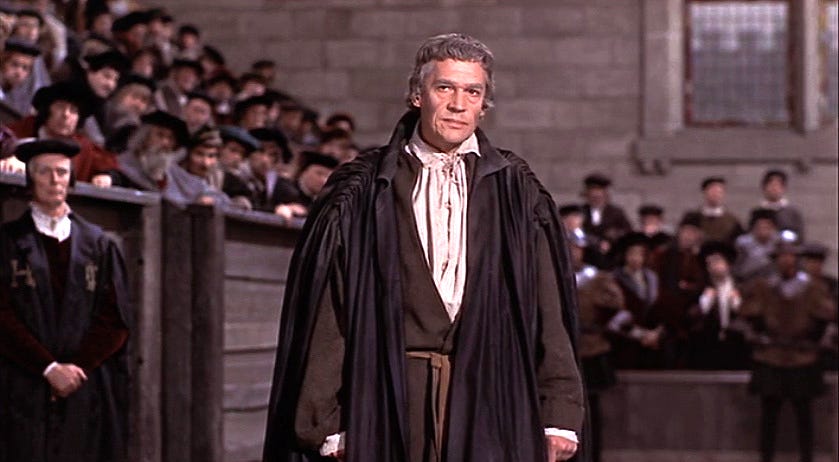
A Man for All Seasons (1966)
“When a man takes an oath, he’s holding his own self in his own hands, like water. And if he opens his fingers then, he needn’t hope to find himself again.”
This celebrated play-to-film stars Paul Scofield in a career-defining role as Sir Thomas More, a Catholic statesman who became a martyr when he refused to sanction King Henry VIII’s illicit divorce. Normally, one would assume that a play about a 16th-century saint was written by a Christian. Not A Man For All Seasons. Playwright Robert Bolt felt a need to explain this in his remarkable preface to the original script. Despite his own atheism, he found that the integrity of this brilliant, stubborn, deeply Catholic lawyer commanded his attention and respect. And through his play, it commands ours, blending material from More’s letters with Bolt’s inspired additions. Is Bolt really channeling the Thomas More of history though, or More by way of Bolt’s favorite existentialist philosophers? Paid readers can find me opining at more length about this here, and if you really can’t get enough of my thoughts, you can find a very fun little podcast discussion I recorded with John Miller for National Review’s Great Books series (RIP).
Using nearly all the actors from the original stage production, the film is shot as sparely as possible. The dialogue—by turns humorous, heartbreaking, and chilling—speaks for itself with no music to underscore it. As the stakes grow progressively higher, More must explain to his friends and even his own family why he cannot take an oath legitimizing the king’s authority to re-marry. To them, it’s just words on a page. To More, it is the difference between saving or damning his own soul. Where other atheists might dismiss More’s execution as a grisly footnote of history, Bolt has turned it into a profound, perpetually relevant tale of conscience.
On the Great Books podcast, Miller and I discussed Kenneth Tynan’s criticism of the play for, in his reading, subjectifying More’s “truth.” For Bolt, it didn’t seem to matter whether Catholicism was true or false. He could be given “irrefutable evidence that every tenet of Catholicism was a palpable falsehood,” yet “his admiration for More would not be diminished.” That was an accurate assessment. As I put it in my old piece, Bolt admired More not because he could identify himself with More, but simply because to his own self, More was true.
By contrast, young ladder-climbing Richard Rich betrays More and thereby betrays himself. I think of Rich often when I consider people in Christian circles who have sold out in various ways (cough, David French). So many occasions to quote More’s scathing little line, “But for Wales?” when he hears that, for his treachery, Rich has been made Attorney General of the small country. The young man could have been a good teacher, More gently tells him at one point. When Rich asks who would know it if he was, More says, “You; your pupils; your friends; God. Not a bad public, that.” Not enough for Rich, though.
Bolt would continue pursuing his fascination with Christianity in The Mission, also well regarded, though not as strong a script as this one. To my knowledge, he never converted. But he created the sort of art that makes good men want to convert.
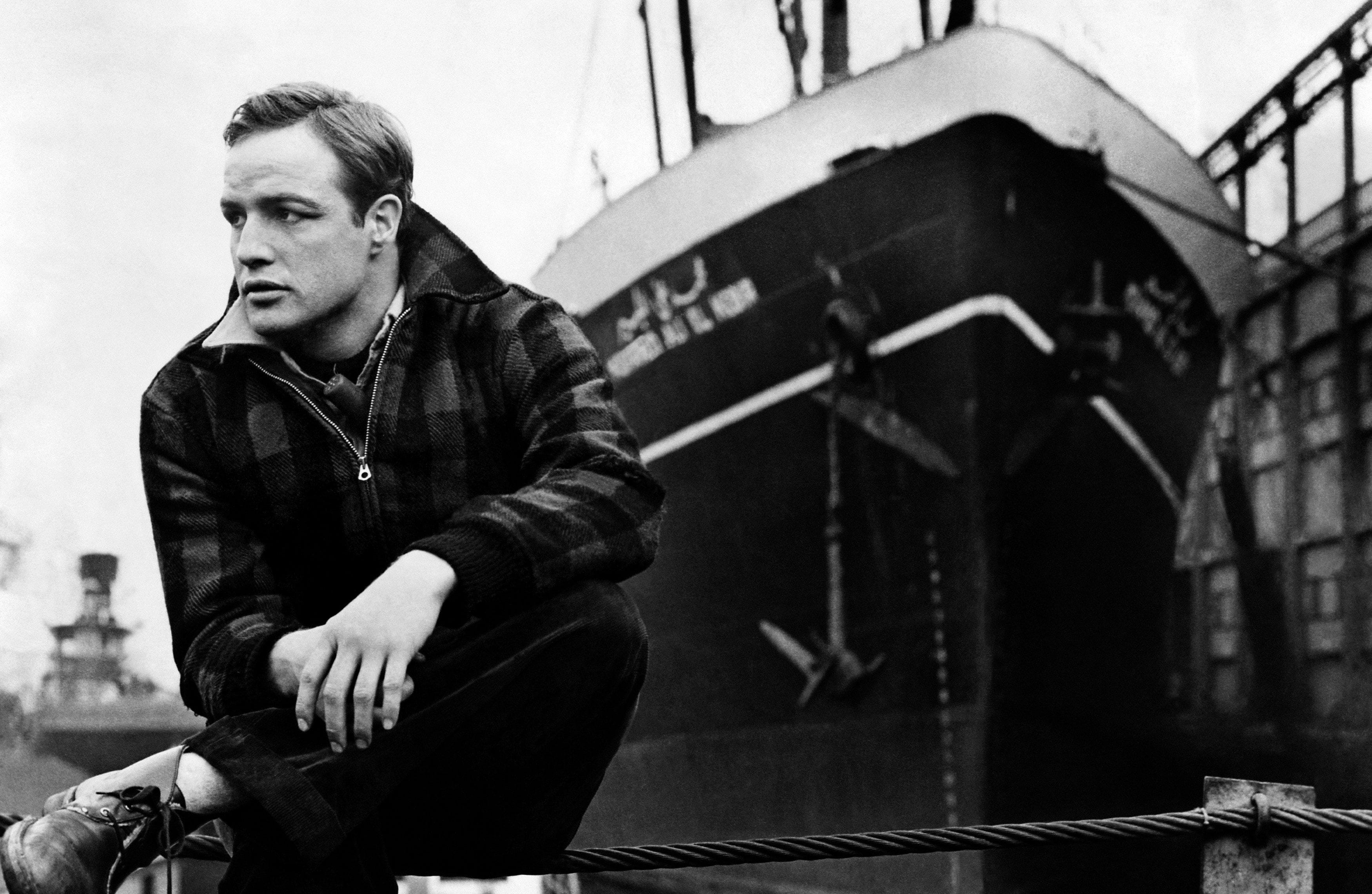
On the Waterfront (1954)
“Conscience. That stuff can drive you nuts.”
If I ever taught a film class, I would pair A Man for All Seasons with On the Waterfront, because both of these films are about conscience. Based on a true 40s crime exposé, it tells the story of how the mob exploited and cowed New Jersey’s longshoremen. Slow-witted but streetwise Terry Malloy (Marlon Brando) has eyewitness testimony that could put the union boss away for murder. But he’s not exactly running to the nearest cop, and he defies you to blame him for it. Fortunately for Terry’s soul, there’s a priest who has something to say about that.
For Christian viewers, On the Waterfront is an especially welcome reminder of a time when the church and its clergy had a voice in Hollywood. Based on a real priest who fought waterfront corruption, the character of Father Barry is tough, fearless and relentless in his pursuit of the truth. In one scene, he preaches over the body of one of the mob’s victims. When they tell him to “go back to church,” he is ready with an answer: “Boys, this is my church. And if you think Christ isn’t down here on the waterfront, you’ve got another thought coming.” Meanwhile, he challenges young Terry to stand up and be counted, even if it costs him his life.
The real-life Father Barry was Reverend John Corridan, whom you can read all about at La Wik here—a Jesuit, of the sort they don’t make like they used to. Screenwriter Budd Schulberg consulted extensively with him while crafting the script. He recalled the priest as a “tall, youthful, balding, energetic, ruddy-faced Irishman whose speech was a fascinating blend of Hell’s Kitchen jargon, baseball slang, the facts and figures of a master in economics and the undeniable humanity of Christ.” Somehow, Corridan made it alive out of his tussles with the waterfront crime-lords, lived out his days as a professor and a hospital chaplain, and died of a heart attack in his 70s.
For director Elia Kazan, the film was his veiled battle cry against the Hollywood communists he chose to testify against—or “rat out,” as the mobsters in the film would put it. But like Terry, Kazan would have replied, “I was ratting on myself all those years.” I used an old YouTube channel to upload a short clip of Kazan justifying this choice, and the comments it drew are interesting, to say the least. Famously, some actors refused to stand up and applaud when Kazan received a lifetime achievement award. If you’ve read Whittaker Chambers’ book Witness, none of this is a surprise. “I don’t mind losing friends,” Kazan says in that clip, “if it’s in a good cause. I also gained a lot of friends.”
Schindler’s List (1993)
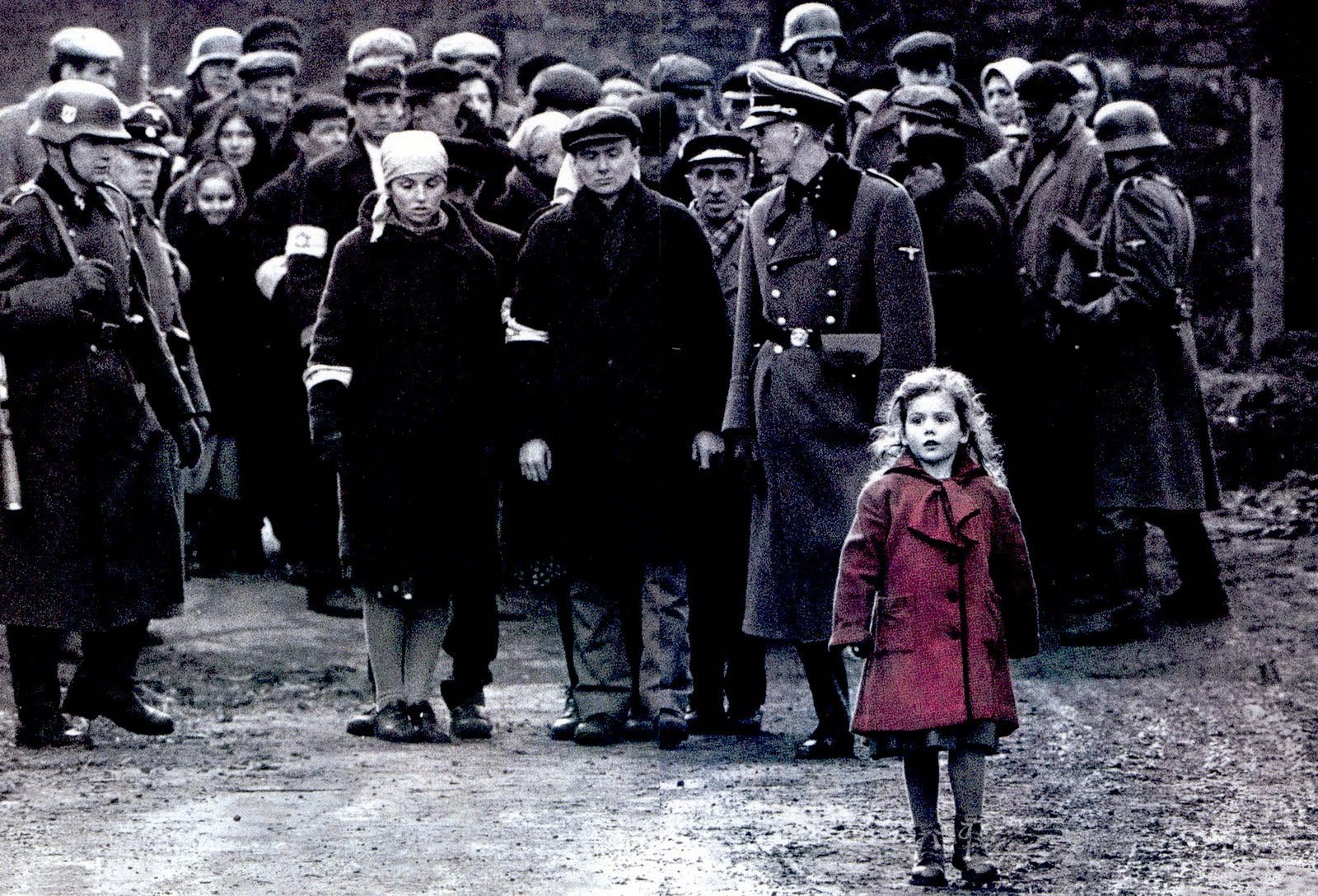
“The list is an absolute good. The list is life. All around the margins lies the gulf.”
Andrew Klavan has expressed a strong dislike for this film, believing it is fundamentally based on (his words) “a lie.” The lie, in his view, is that it put itself forward as the definitive Holocaust movie while focusing on a handful of Jews who were heroically saved. But the handful of Jews Schindler saved were not the story of the Holocaust. The 6 million dead were.
I have never really understood this perspective, and after freshly rewatching this film the other night, I understand it even less. Hardly a scene goes by that the viewer is not excruciatingly reminded of “the gulf” which, in the words of Schindler’s assistant Itzhak Stern, lies “all around the margins” of The List. I include it among films every Christian should see, but I feel I need to add an asterisk exempting those who can’t bear scenes of wanton bloody executions, degrading nudity, or sexually charged abuse. Then of course there’s the crushing final scene where Schindler dissolves into sobs and cries, “I could have gotten more!” Yes, in that moment Stern urges him to concentrate on the 1,200 people snatched from the fire, but we understand very well why he cannot. It’s worth noting that Spielberg donated his share of the film’s profits to the Shoah Foundation, which is dedicated to preserving firsthand accounts of the horror.
Klavan also says the film bothers him because just as most of the Jews were in fact not saved, most of the people around the Jews were in fact not heroic, and if you were honest you would probably not have been heroic either. I wonder if Klavan believes this means the heroes’ stories should have remained indefinitely untold, or at least untold through the medium of film. Does he feel the same way about Raoul Wallenberg or Corrie ten Boom?
There is also the fact that the film does not portray Schindler as purely and simply heroic, which is part of why it’s so great. He squirms repeatedly at being called a “good man.” At first, he complains when Stern sneaks in clearly less than “essential” workers, like the pitiful one-armed man who is the film’s first executed victim. Through all kinds of visual cues, the viewer is constantly reminded that Schindler and the villainous Amon Göth are two sides of one coin. There are moments where Schindler raises his voice with an unnerving guttural harshness, and we glimpse the kind of man he could be, if he chose. At a birthday party, he impulsively kisses a Jewish woman, intending her no harm, but she has no way of knowing this and begins quaking all over. (Göth, with his own personal stake in this area, intervenes to help wheedle Schindler’s way out of the fact that he’s broken a Nazi regulation.)
Roger Ebert praised Spielberg for “disappearing” into the work of the film, eschewing directorial flourishes. There are of course those very few haunting touches of color flaming up in the black and white cinematography—the fire of a candle, the red coat on a little girl. On the negative side, one could make the case that a couple scenes are a bit cheap/exploitative, like the scene where a train of women gets mistakenly routed to Auschwitz and they believe they’re about to be gassed, only for water to come out of the showerheads. Moments like this risk tilting the whole venture into horror-movie territory, but then again in some sense it already is a horror movie.
While I’ve picked my bones here with Klavan’s criticism, there is another kind of criticism that’s much more insidious and launches itself specifically in the guise of Christianity. After finishing my rewatch, I was closing tabs and found a YouTube video from a roundtable podcast featuring some 30-40-something pastors in name only who’d all gotten together to blather about Christianity and Judaism. Among other mind-numbingly stupid things, they were explaining why it’s a trap to say that Jesus was Jewish. These PINOs also like to sneer about the “sacred number” of 6 million and hold forth on the dangers of “Holocaustianity,” which has been used to “bludgeon” white men into believing they can’t have a country—or something.
If all was well with the church, we could just laugh off this crackpottery and get on with our lives. As it is, it seems to be spreading among quite a few younger people in the pews, including Catholics and Protestants, men and women. Much more needs to be written about this, but suffice it to say I fear some older pastors and priests are asleep at the wheel. The sad thing is, it will no longer work to simply show a film like this for educational purposes. An entire generation is being immunized to it. Which is all the more reason for Christians to watch it.
Spotlight (2015)

“If it takes a village to raise a child, it takes a village to abuse one.”
I don’t rate this film as highly as my other picks here, but it is hauntingly made, a sober dramatization of the exposé that blew the Catholic Church’s abusive priest scandal wide open. Though I understand why Bishop Barron was frustrated by the closing credits’ list of cities and dioceses implying that the Church had failed to respond wherever the rot had been found. This was not in fact true, and so I think a good bishop like Barron is entitled to a little irritation in response. Yet at no point has anyone denied the scope of the rot. The slow unfolding horror of the film is that it’s not even difficult to prove, in the sense that these cases are overflowing with hard evidence. Getting one’s hands on said evidence is the rub.
I’m not Catholic, nor have I ever been tempted across the Tiber, much as I respect my neighbors over the way. I’ve had friends who crossed the river in both directions. In at least one case I know, sadly, someone crossed it all the way from Catholicism to atheism. The journalists in this film are already less than completely devout, after the usual fashion of lapsed New England Catholics. But there’s a heartbreaking scene where Mark Ruffalo’s character says he’d always been drawn to the Church, even though he’d fallen away over the same “typical shit” as everyone else. But, he says half-laughing, half-crying, “I figured one day I might actually go back. I was holding on to that.”
Rod Dreher has written movingly about how his own journalistic journey into the scandals led him out of the Church, for which a lot of Catholics continue to excoriate him. He was accused of allowing himself to be led by emotions and throwing reason out the window, to which he responded—justifiably I think—that it was not a purely emotional response. Catholicism makes certain very bold claims about itself that are cast in doubt by corruption on this scale. One can of course still remain in the Church as a faithful layman or priest, and while it may sound a bit odd coming from a Protestant, I’m glad so many have. But I also see why so many haven’t. The tragedy is that so many believe their only alternative is nothing at all.
This film will hit especially hard if you’ve known any male clerical abuse victims. There’s a scene where the female lead speaks to a damaged, effeminate young man who explains that she has to understand, “this was the first time anyone had told me it was okay to be gay. And it was a priest!” And my heart breaks, because that’s exactly what my friend said too.
There is of course such a thing as overzealous activism, pushing so hard that the very concepts of due process or “innocent until proven guilty” are called into question, or people are tainted by association at many degrees removed. I’ve seen how this dynamic can sometimes play out with abuse advocacy in a church context, and it’s endlessly frustrating because it keeps cycling in an endless loop with actual coverup culture.
Still, when whistle-blower Phil Saviano speaks in this scene, you can’t blame him for sounding like a man on the edge of sanity when he says, “This is all right here in the box. I sent this all to you guys five years ago.”
What are your Oscar favorites? Comment below and let me know!
At the risk of repeating some things Bethel has already said, here’s my suggestion for redeeming every Labor Day Weekend from America's favorite pastime, shopping. Watch Elia Kazan’s brilliant On the Waterfront. Mobsters infiltrate the unions; the protagonist rises above all odds; and bonus—a favorable portrayal of a Catholic priest!
I long ago quit watching the Oscars, but I’ll never forget 25 years ago when the Motion Picture Academy gave Kazan, by this point well into his eighties, the Lifetime Achievement Award. There sat Nick Nolte (who never rose above the performance the brilliant Walter Hill got out of him in 48 Hours), with not one one-hundredth of the talent that Kazan had in his pinky toe, with his arms folded across his chest refusing to applaud much less stand up. The vastly overrated Steven Spielberg (his best film was Jaws, by far, though Hooper in the book is not a sniveling kid), if I recall, did applaud but refused to stand. At least he recognized genius. Ed Harris (who is very talented and just nothing but great in Apollo 13)) also sat still and glared, hands folded in his lap.
Why? Kazan had identified communists, not, interestingly enough, in Hollywood, strictly speaking, but writers for the New York stage—among them Arthur Miller. We dismiss the whole business now as “red scare,” and the (also much overrated) Cohen brothers lampoon the period in their (admittedly funny) Hail Caesar, but those of us who move every day in the business of distinguishing truth from falsehood know how harmful the latter can be to a polity, and we know the duty of the state to identify it and expose it.
I was very taken by A Man for All Seasons when I first saw it long ago. I even have a soft spot for the Charlton Heston (let's be clear--more movie star than actor) remake, which is more faithful to the script, if memory serves. But in the end the play is a defense of conscience, not truth, and Bolt is explicit as Bethel says. Fun fact: Vanessa Redgrave, in the Scofield film, plays Anne Boleyn. It's not a speaking role. (It's not among the players for the stage production.) She briefly appears exchanging goo-goo eyes with Henry (the brilliant Robert Shaw, who steals Jaws) before he enters court near the beginning of the picture. Its a masterful scene: Zinnemann (watch High Noon, Day of the Jackal, and the Nun's Story) shows in a few frames that Henry is throwing it all away for for a piece of flesh. Of course his "Great Matter," as it came to be called, is the most "impactful" event in modern history, spawning the ugliness of the industrial revolution, the ethnic cleansing and genocide of natives of today's United States, and a schism in the Church yet to heal.
Redgrave's role is among the two greatest non-speaking roles in cinema. The other is Robert Duvall's Boo Radley in To Kill a Mockingbird. Screenwriter Horton Foote (watch A Trip to Bountiful and Tender Mercies) takes a children's book, as Flannery O'Conner put it, and with Gregory Peck makes a pretty compelling if sentimental film.
Ben Hur, the 1959 version. Quite possibly the best action sequence ever filmed is in this movie. Jesus isn’t in this much, but His presence is substantial.
I know this will seem strange considering the context of best Christian films, but the Godfather parts 1 and 2. The rise and fall of a good man consumed by violence and wiping out all his enemies. A cautionary tale, a biblical tragedy, or maybe a Greek one.🧐
I really enjoy Best Years of our Lives. A melodramatic window into post-WW2 America. Great deep focus cinematography, too.
Not an Oscar winner as far as I know, but I would also recommend High and Low, a Kurosawa/Mfune collaboration. The film is centered on a powerful moral dilemma. Great blocking especially in the first act.