

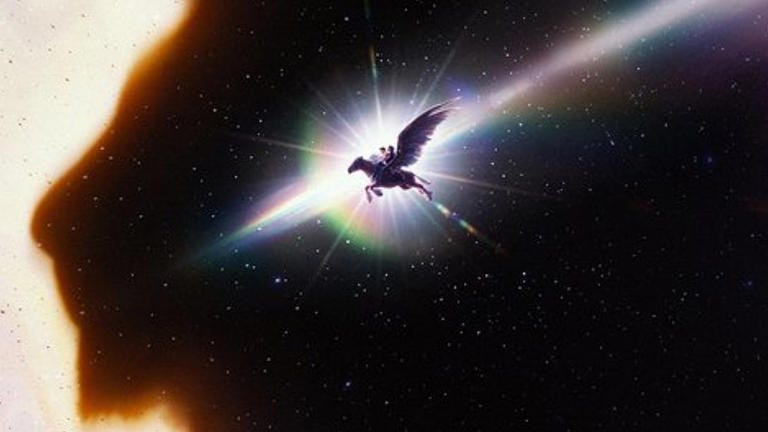
I have a confession: I like Greta Gerwig, even though she annoys me. I’ve written about why she already annoyed me even before I learned she was going to do weird stuff with her adaptation of The Magician’s Nephew for Netflix. The main Discourse around that adaptation has focused on her choice to cast Meryl Streep as the voice of Aslan. Writing for The Daily Wire, I observed that this is just the latest in a line of feminist choices in her filmmaking, from the decision to scrub out Jo’s marriage in Little Women to the emasculating portrayal of Ken and his fellow witless guy dolls in Barbie. Beyond this, Gerwig announced that she was taking other stylistic liberties with the aesthetics of Narnia, infusing it with a confusing jumble of Things Greta Gerwig Likes which may be cool in their place, yet make little sense when superimposed onto Lewis’s vision. Now that we’ve gotten a first trailer…well, see for yourself:
As the kids say, there’s a lot here. Why is Jadis dressed in a disco ball? Why does Charn look like the inside of a broken pinball machine? Why do the backdrops look more like Grok-generated screensavers than like worlds you can reach out and touch and smell? And why is Led Zeppelin the soundtrack to all this? What are we watching, Guardians of Narnia? The Magician’s Avengers? And how did all of this get greenlighted by the Lewis estate, which just put out this strangely bland response to the early backlash? Douglas Gresham has been declining with dementia for some time, so it is currently unclear exactly who all is driving the bus over there. Whoever they are, at this point they seem to be shifting into damage control mode.
Still, I won’t lie, there are individual moments in this trailer that I liked. Daniel Craig, while perhaps too handsome to play Uncle Andrew as a loathsome creep, is giving off subtly sinister vibes. The foreshadowing shot of wings on a bus behind Strawberry is very nice, even though I remain confused about why Digory and Polly are in a bombed-out 40s London as opposed to the London of Sherlock Holmes that Lewis so vividly evoked. (Gerwig has said the shift is motivated by the formative role World War II played in the imagination of her favorite rock artists, whose music was the creative fuel for this adaptation—more on this in a moment. I’m also not alone in suspecting she has hopes and plans for a modernized Lion, Witch and Wardrobe.) And, to address the lion in the room, the first look at a cosmically glittering Aslan under a veil of stars is nothing if not intriguing.
Perhaps unsurprisingly, Meryl Streep’s voice is nowhere to be heard in the trailer. Someone suggested that Aslan’s closing roar is a female voice, but it appears to be just looping back to screaming Robert Plant. Meanwhile, the word from a private screening is that the actress’s performance has been post-produced into something so low and gravelly, it raises the question of why she was cast in the first place. Was Gerwig just trying to provoke hard-core fans of the series? Was she creating Discourse for Discourse’s sake? Is she like Jadis in this trailer, using her wand to blow out the windows of The Eagle and Child (another jarring departure from the book, as Jadis in fact finds herself impotent to do anything magical in our world but still causes havoc with her sheer size and strength)?
You could make a case for all of these things, but I’m not sure it’s quite that simple. Because, as I confessed, I kind of like Gerwig. I was reminded why when I listened to her conversation about the making of the film with Stephen Colbert. There’s a winsome sincerity in the way she talks about the craft of filmmaking in general and adapting Narnia in particular:
In the same way, I found myself curiously drawn into Gerwig’s commentary on adapting Little Women, even though I was deeply annoyed by how she retconned Jo March’s story to reflect her vision of Louisa May Alcott’s proto-feminism and rob us of the romance Alcott herself wrote. It’s obvious as she talks that we’re listening to a highly intelligent filmmaker with a deep well of creative energy—someone who could go on a Rogan-style podcast and talk for endless engaging hours about story, movies, and writing:
It might fairly be said that movies are Gerwig’s religion. In a behind-the-scenes interview for Barbie, she talked about having the cast watch a classic film of her choosing every Sunday morning—a church substitute? Speaking with Colbert about Narnia, she talks passionately of the act of filmmaking as “an act of faith.” She had The Magician’s Nephew shot on celluloid, which means you have to wait until the film is developed to know for sure whether you caught something good. One of the byproducts of this process is a bit of silver. These silver bits were collected and turned into a silver pin Gerwig wore, in the shape of Aslan and the story’s pivotal apple tree. She proudly showed it off to Colbert: “This pin is made from my movie,” and it represents the “act of faith” that was its creation. And of course, the story is a creation story. This has captured Gerwig’s imagination, because she sees herself as a co-creator with the divine. One might say that moviemaking isn’t even just an act of faith for her, but an act of worship.
Worship directed to what, though? Well, that’s the question that niggles when we come to Narnia, where Aslan has a very particular shape and is meant to evoke a very particular God.
Even putting aside the Streep-casting, there’s something odd in the way Aslan appears in the trailer to be made of stars. It’s visually striking, yet it suggests the blurring of a boundary between the stars and their Maker. The posters giving a first look at Aslan’s more solidly incarnated appearance aren’t very reassuring, as his face looks like a patchwork quilt of fur, feathers and even scales. His eyes are also differently colored, an apparent nod to David Bowie’s illusion of heterochromia. What this is all meant to add up to is confusing, to say the least. Perhaps there’s some reassurance in the fact that Gerwig used male pronouns for Aslan throughout her interview, and in the fact that it appears he will at least have a mane and a terrifying roar. But there remains the impression that Aslan’s image is an admixture of elements, an entity bound up and fused with nature in ways that are decidedly not aligned with Lewis’s vision.
This brings me to Led Zeppelin, who made the historic choice to give Gerwig their blessing for “Stairway to Heaven” to be used in the trailer. Most takes have focused on the rock anthem’s bizarre tonal clash with a Narnian oeuvre. It is indeed bizarre, but if you look at the lyrics, you can begin to see Gerwig’s creative logic, which is not entirely crazy.
The mystery “lady,” whose identity has been much debated over the years, could be Jadis: a character for whom “all that glitters is gold,” who intends to “buy” a “stairway to Heaven.” As Aslan says, “All get what they want. They do not always like it.” But what does the song offer as an alternative to this lady’s materialistic grasping? Well, a mystical encounter with Nature, naturally:
And it’s whispered that soon if we all call the tune
Then the piper will lead us to reason
And a new day will dawn for those who stand long
And the forests will echo with laughter
(Oh-oh-oh-oh-woah-ho)
If there’s a bustle in your hedgerow, don’t be alarmed now
It’s just a spring clean for the May queen
Yes, there are two paths you can go by, but in the long run
There’s still time to change the road you’re on
So, paganism. More or less. Bring your own bong.
Your head is humming and it won’t go, in case you don’t know
The piper’s calling you to join him
Dear lady, can you hear the wind blow?
And did you know
Your stairway lies on the whispering wind?
Here I actually think of that lovely scene in The Wind in the Willows where Mole and Rat are startled by Pan in the woods. And for that matter, we might think of Lewis’s own dancing dryads and naiads, of their reenchanted bacchanalia sans vice at the end of Prince Caspian. The sort of thing that drove Tolkien crazy precisely because it made for an odd mashup with the stories’ heavily Christian symbolism. Of course, Lewis had always been drawn to pagan myths. By bringing these creatures into Aslan’s orbit, he meant to convey how their wine and song and dancing might be reimagined not as pure hedonism but as the full partaking of Aslan’s good gifts—just as the wedding guests partook fully of Jesus’ wine ex nihilo, the very best saved for last.
But Greta Gerwig doesn’t approach Narnia with Lewis’s baptized pagan understanding that salvation does not come simply by following a piper’s siren song into the forest of mystical enlightenment. She was raised in the Unitarian Universalist “church” and attended Catholic high school, with predictable results. She’s on record saying that she always found “Jesus Christ is my Lord and Savior stuff” to be “creepy” and the idea of God the Father “alienating,” though she was intrigued that Catholics “worship the Virgin Mary.” (No, we’re not going to go down the Catholic rabbit trail here. Resist, resist.) For all the good will and earnestness with which she insists that she’s “tried to read everything Lewis wrote” (which left her wide open for fan jokes that wrote themselves about works like the “OHEL,” Lewis’s massive English Literature in the Sixteenth Century tome), she is simply and sadly unable to understand him. This is clear in the way that she points to “Stairway to Heaven” as a summary of the book’s theme. I believe that she believes it. But that isn’t very reassuring.
Interestingly, Robert Plant himself has shown a reluctance in recent years to claim the song as a favorite. He’s reflected back on it as very much a song of its time, and also very much a “23-year-old’s” song. With age, he feels less attached to it. It represents something he feels he’s grown out of. Against this, maybe one could set Lewis’s words about never being too old for fairytales. And that “feeling I get when I look to the west/And my spirit is crying for leaving” might be sehnsucht, the desire for we-know-not-what. Perhaps Gerwig feels it too, though she lacks the vocabulary to baptize it with a Christian name. As well as in cinema, it is in music and songs like this that she finds something spiritually resonant, salvific even. In her own words, rock music “saved” her. In her mind, it is as if adapting Narnia for the screen has become the grand symphonic intersection of all her great loves all at once, all the things that have saved her. But if everything is salvific, nothing is.
This is all very well for Gerwig, but meanwhile, those of us who love Lewis’s books are left understandably frustrated that after all this time, Hollywood still can’t seem to get Narnia right. The old Lion, the Witch and the Wardrobe movie was a decent effort, in spirit certainly closer to the book than whatever Gerwig is doing, but it left much to be desired. The sequels then wandered so far afield that audience interest took a nosedive, along with any hope of the series’ recovery. It was a tragic fumble, given that the timing was right for the cinematic treatment fans would have lined up in droves to see. Now that a filmmaker of Gerwig’s talent and stature has been handed the keys to the kingdom, another golden opportunity seems to be going to waste. When I was in D. C. recently, I got to see Logos Theater’s stage production of Prince Caspian, one of several productions that are beautifully faithfully to the books. (Reviewed here in my travel diary for paid readers.) I told one of the producers that I wished they could be simply handed a budget to make the films. I was entirely serious.
There are rumblings of trouble behind the scenes of the production, included studio-mandated reshoots. Whether the final product will explode or flop remains to be seen. If it does flop, I can find it in my heart to feel sympathy for Gerwig. She sounds almost on the verge of tears as she discusses the project with Colbert, so close it seems to be to her heart. I can imagine there will be moments in the film when her love for the source material is evident, even if she loves without understanding. Alas, love without understanding can yield only half-truths. We can only hope the echo of Lewis’s vision will, however faint, spark a fresh return to the source, and the whole truth found there.