

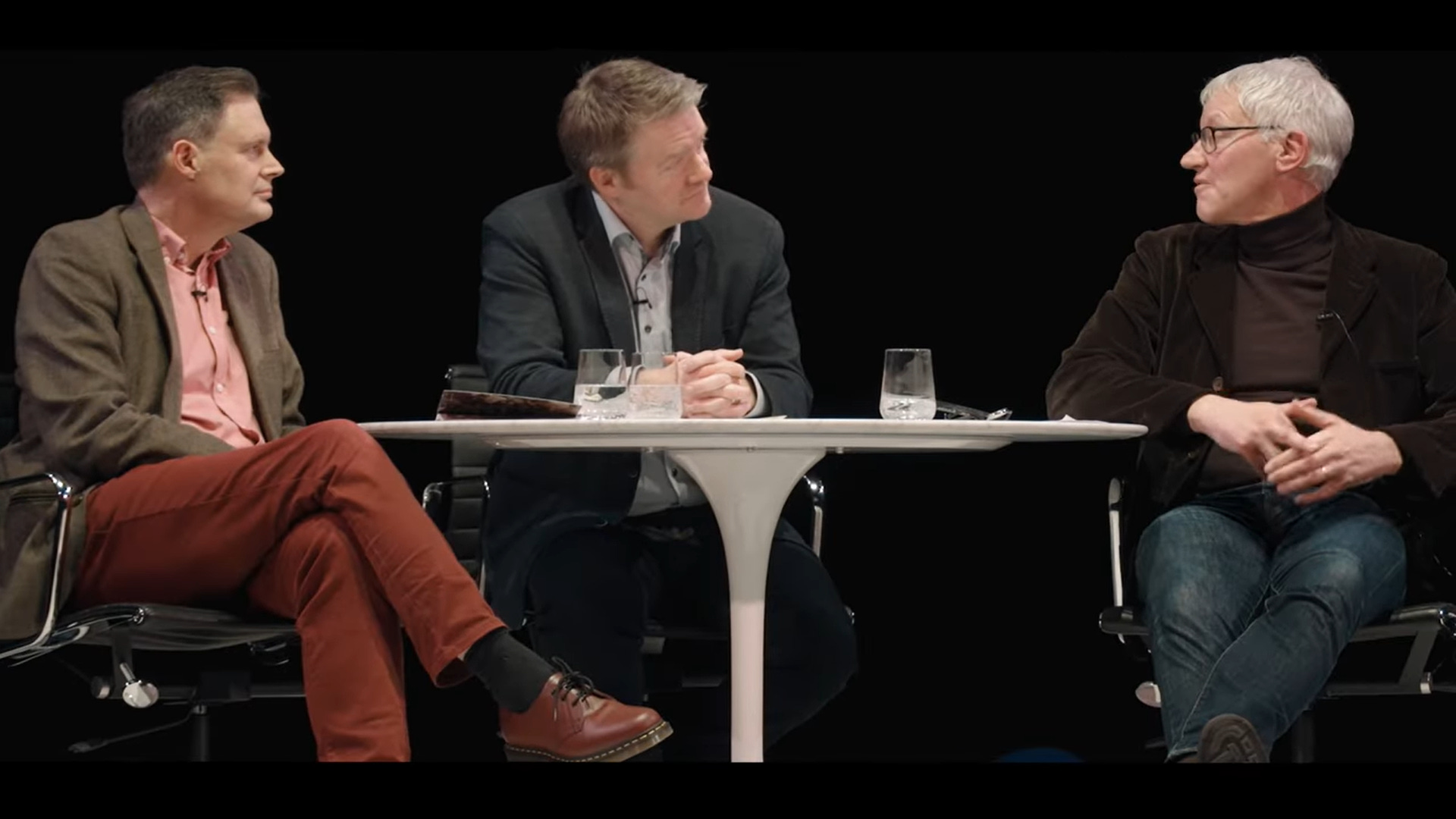
I’m jetting off on a bit of an impulsive trip to New York for the week, so to help tide you all over, my mom has graciously agreed to lend her very particular set of skills to a free assessment of Tom Holland’s recent conversation with Peter Williams and Justin Brierley about Jesus, the gospels, and the intersection of history and Christianity. For some of you, Mom needs no introduction. Others might have recently started looking into her work thanks to a generous shout-out from Ross Douthat on the Bishop Barron show. Here’s a little laundry list of her accomplishments:
Dr. Lydia McGrew is a widely published analytic philosopher and author. She received her PhD in English from Vanderbilt University in 1995. She has published extensively in the theory of knowledge, specializing in formal epistemology and in its application to the evaluation of testimony and to the philosophy of religion. (See here for her curriculum vitae.) She defends the reliability of the Gospels and Acts in four books, Hidden in Plain View: Undesigned Coincidences in the Gospels and Acts, The Mirror or the Mask: Liberating the Gospels From Literary Devices, The Eye of the Beholder: The Gospel of John as Historical Reportage, and Testimonies to the Truth: Why You Can Trust the Gospels. Testimonies to the Truth has recently become available in audiobook form in addition to other formats (read by yours truly).
Mom’s comments are primarily focused on the more scholarly elements of the dialogue. Tom and Peter also ventured into some interesting waters around “cultural Christianity,” on which I might add a few thoughts later. For now, please enjoy Mom’s take!
I have been asked to write some comments on “Is there evidence for Jesus?” an erudite debate between historian Tom Holland and biblical scholar Peter Williams, deftly moderated by Justin Brierley.
It will come as no surprise that this article comes down rather strongly on Williams’s side, despite some differences of emphasis. But before you dismiss this as merely a matter of “Christian agrees with Christian,” a few points to counter that impression: First, I am (infamously) no stranger to disagreeing, even disagreeing sharply, with fellow Christians. Second, the areas in this dialogue on which I disagree with Holland and agree with Williams, particularly faith vs. reason and the literal truthfulness of the Gospel authors, are places where Christians often disagree strongly with other Christians. There are, for example, Christians who hold as firmly as Holland does to an opposition between faith and evidence, and in this respect differ from both Williams and me, while there are skeptics who would agree with Williams and me, over against Holland, that religious faith ought to be supported by evidence in the rough and tumble of historical inquiry. Of course, any such skeptics think it isn’t supported thus (or they wouldn’t be skeptics), while Williams and I think it is, which leads me to a third note: While I gratefully acknowledge and cite Williams’s information at multiple points in two of my own books, there are goodly swathes of territory which he and I have evaluated independently of one another, from which we have both concluded that the claims of Christianity are strongly supported in an evidential, historical manner.
My notes on the Holland-Williams discussion fall broadly under two thematic headings. One of these concerns a pair of concepts that Holland tends to conflate or, at least, to bounce back and forth between, while I think they should be kept sharply distinct. The other concerns a pair of concepts that he opposes to one another, while I think they should be seen as complementary.
Repeatedly in the discussion, Holland will state something uncontroversial: That people sometimes make mistakes in writing history, implying thereby that the Gospel authors might have made some mistakes.
These kind of SNAFUs are absolutely common in ancient literature. I mean, so I’m preparing a series for The Rest is History at the moment on Hannibal, and we have a very detailed account of the wars that Hannibal fought against the Romans from this guy Polybius who was writing maybe 40, 50 years afterwards, so that’s maybe the distance between Jesus and the gospel writers, and he gets quite a lot of things right, but he clearly gets things wrong as well, and that’s what you’d expect. I mean journalists have been known to get things wrong, and they’re reporting things on the day. So I think it’s not unusual for historians in antiquity.
And later:
There are lots of passages in ancient history where you have similar bits where people have got things wrong—you know, people fighting who would have died six years previously or something like that—and it’s obvious that, you know, writing in antiquity, you don’t have the Internet. You often maybe don’t have access to the texts that you need. It’s very easy to get things wrong.
From a purely human, historical point of view, the implication that the Gospel authors may have made a mistake is not improbable. Indeed, when one has enough propositions in a particular set of texts, it becomes increasingly probable that one or another of those propositions is false (an issue known in philosophy as the paradox of the preface). Even if a scholar is religiously committed to the view that the Gospels and Acts are completely without error, he may not find that view supported by the concrete data. If he merely thinks they are “inerrant” in the more boring sense in which any writing by any person might happen to be inerrant—namely, that he hasn’t yet found anything in them that he thinks is an error—this, too, is subject to historical refutation. To put my own cards on the table, I am not an inerrantist in either sense. I think the Gospels have a few relatively minor, non-deliberate errors.
But interspersed with these statements, which one takes to refer to non-deliberate errors, are Holland’s implications of something both more interesting and more open to question—namely, that the Gospel authors considered it quite legitimate to make up historical statements and to narrate them seamlessly as if they were true, while knowing that they were false. And that they sometimes did just that.
In fact, one of the above references to what sounds like mere error was Holland’s answer to a question from Justin Brierley about deliberate change. Holland’s mention of SNAFUs and Polybius is his response to this implicit question from Brierley:
But then as you say Tom, you’ve got some concerns about bits where you feel there’s been obviously some sort of fabrication or exaggeration.
Brierley is correct. Holland’s concern isn’t just about accidental errors. For example,
There are passages that are being determined by considerations other than a concern with documentary accuracy. But I don’t think documentary accuracy is really what the Gospels are about. I mean they kind of do reflect, I think there is a kind of documentary quality to them, but that’s not what the Gospel writers are setting out to do. They’re not setting out you know like Boswell writing the life of Johnson to make it…the accuracy is not the prime consideration in terms of that, the concern is to demonstrate that Jesus is what the Gospel writers say he is.
And,
I don’t think that getting the granular documentary detail 100% accurate is the prime concern of either Matthew or Luke. Their prime concern is to demonstrate that Jesus is what Christians say he is, and occasionally their attempt to convey that leads them into thinking in terms of poetry, I think. And I think that there is a poetry about the angel appearing to the shepherds, or the wise men coming, or even the massacre of the innocents in all its horror that is, for the writers of the Gospels, profounder.
And even,
I think also it’s clear that in all the Gospels and in Paul’s letters as well, there is a sense that Jesus’ life and death and resurrection are fulfillments of Scripture. I mean, I think it’s evident that Paul, who we know didn’t believe—thought Jesus was a scoundrel and a scam—then has this incredible, literally blinding moment of revelation. And I think he clearly goes away, and he reads through the Scriptures and he says, “Ah, this…” you know, it’s like in an Agatha Christie novel, you suddenly get the solution, and everything that you’ve seen in one way, suddenly you’re seeing it in a different way. I think there is an element in which that is clearly true of the Gospel writers as well. And there is a sense that, you know, it’s great if Jesus is a descendant of David, it’s great if it’s a fulfillment of a prophecy in Micah, and all kinds of clues that people who believe that Jesus is the risen Messiah. They are obviously going through Scripture trying to find evidence for this. And in their lives, their proclamations of good news, their Gospels, understandably, they are working that in, and they don’t see this as fraudulent. They see this as being conclusive proof of what they believe. But it maybe gives rise to traditions that may not be entirely historically accurate.
So not only did the Gospel authors consider it legitimate to change and invent facts on purpose to fit with their religious commitments, they also didn’t “see that as fraudulent.”
Now all of this goes far beyond the claim that people make mistakes. We all know many fallible people who never deliberately fabricate while making their fabrications appear seamlessly historical. At least I know many such people, and I think that I’m such a person myself. And, crucially, we trust such people’s accounts accordingly when they tell us about things that lie within their own knowledge.
Moreover, even when a person does fabricate and thinks he’s justified in doing so, one normally assumes that he is capable of “seeing it as” a deception. It may well be morally allowable to lie to searching Nazis about the location of fugitives’ hiding place, but to think so is not to be confused about the fact that one is conveying false propositional content. Indeed, doing so is exactly the point—one is trying to deceive and confuse the evil searchers. A person who deliberately misleads others while telling himself that he isn’t doing so is a person with a rather serious problem.
To say that the Gospel authors thought they were licensed to change facts and even “didn’t see it as fraudulent” is an unfortunately popular claim but one that does not square with the evidence. There was no “ancient view of truth” that made ancient people in general incapable of knowing the difference between literal truth and literal falsehood when it concerned a matter of importance to themselves. As classicist Colin Hemer says,
Ancient biography, no less than ancient historiography, may need to serve as a historical source. The question here is whether the work is a good source. And it needs to be measured by the stricter rather than the laxer measure. Rigorous concepts of history existed in Luke’s world.[1]
Nor is a loose or confused view of empirical facts typical of early Christians, a point I have documented extensively in my book The Mirror or the Mask. To give just a few examples, Acts portrays Peter and John as telling the religious leaders that they will not stop preaching that Jesus has risen from the dead, because, “We cannot stop speaking about what we have seen and heard” (Acts 4:20). I Peter 1:16 explicitly states, “We did not follow cleverly devised tales when we made known to you the power and coming of our Lord Jesus Christ, but we were eyewitnesses of His majesty.” Luke is extremely explicit:
It seemed fitting to me as well, having investigated everything carefully from the beginning, to write it out for you in an orderly sequence, most excellent Theophilus; so that you may know the exact truth about the things you have been taught. (Luke 1:3-4)
You may say that these statements are false, that the early Christians, including both the apostles and the authors of the Gospels, really are both following and purveying made-up tales, but it is simply historically inaccurate to say that, in religious matters, they don’t understand the difference between literal truth and falsehood or that they don’t present themselves as telling the literal truth. If they are not doing so, they are committing a rather serious type of fraud, attempting to induce others to think that their stories are true and to order their lives accordingly, while knowingly including made-up tales as history.
This point is especially relevant in precisely the area where Holland suggests a weak Christian view of literal truth—the fulfillment of prophecy. As a matter of mere logic, if a particular event did not really occur in history, then the prophecy in question was not really fulfilled by that event. I have elsewhere referred to this principle by the phrase “Fake points don’t make points.” The evangelists understood this quite well. The Fourth Evangelist is quite explicit. He insists that he knows that Jesus fulfilled an Old Testament verse (“not a bone of him shall be broken”) because he personally saw that Jesus’ legs were not broken at the crucifixion, because Jesus was already dead, and that instead a soldier pierced his side with a spear, bringing forth blood and water (John 19:31-37). The gory nitty-grittiness of the statement should not be airbrushed out. It is not good historical practice to claim that, yes, he says that but he doesn’t really mean it because those ancient Christians were grappling with a big religious epiphany and hence didn’t think that making things up and presenting them as true counted as lying.
The famous question of the census mentioned in Luke 2 was a focal point of the debate, including the question of whether Luke sometimes fabricated events. Williams suggests that Luke has enough confirmed accuracy elsewhere to merit historical trust on this particular point and that we should let the matter be thrashed out in the arena of historical research rather than assuming that Luke invented the census at the time of Jesus’ birth. Holland suggests that Luke invented things in his birth narrative, apparently including placing a census at that time, to compare and contrast Jesus with Caesar Augustus. And Holland dismisses any solution to the alleged contradiction with Josephus which places an emphasis upon the Greek word “prōtē” in Luke’s account, which is sometimes translated “first.” The NASB renders it, “This was the first census taken while Quirinius was governor of Syria” (Luke 2:2). Holland goes so far as to suggest that attempts at harmonizing Luke with Josephus here are the equivalent of Jesus mythicism on the other side, clearly springing from ideologically motivated thinking.[2]
Without being tempted into a long digression on the census, I will simply say that harmonization is actually an entirely legitimate “secular” enterprise. If a historian many centuries hence reads in a 21st-century source that Donald Trump was elected President of the United States in 2016, and if another source declares that he was elected President in 2024, it would not be religious ad hocery for the historian to suggest that it might have been possible to be elected President more than once in non-continuous terms. In The Mirror or the Mask I several times suggest harmonizations of Plutarch’s Lives with one another or with other ancient historians, though of course I have no religious commitment to Plutarch. Harmonization is just another historical tool to be used as reasonably as one can while trying to account for all the available data.
My own preferred solution to the census issue is that Luke is not referring to the A.D. 6 census (which he is well aware of in its proper time frame, as shown in Acts 5:37) but to another census which Josephus does not directly record and that he has made a minor memory slip between “Quirinius” and “Quinctilius.” P. Quinctilius Varus was indeed governor of Syria during the reign of Herod the Great, which is when Luke places the birth of Jesus (Luke 1:5).[3] This idea is suggested by classicist John Thorley.[4] The point here is that this is not a religious suggestion but a historical one, an attempt to decide the truth of the matter about the history of the region in question, using multiple historical sources. Williams alludes repeatedly and rightly in the conversation to the fact that the “desperate Christians need Luke to be right about the census” narrative simply does not fit.
But in the context of the birth narratives, Holland himself makes an interesting slip. After accurately stating that the massacre of the innocents occurs in Matthew, Holland later seems to imply that it occurs in Luke and is part of a pattern of thematic historical invention on Luke’s part:
I think that particularly in Luke’s Gospel there is a sense of the cult of Augustus and that there is a degree to which the life of Jesus is a counterpoint to the life of Augustus, and that’s what Augustus is… you know Augustus is there at the beginning, it has to be Augustus, that’s why it’s a global tax, because it’s the global sweep of Caesar, and the birth of Jesus in poverty and obscurity is a deliberate counterpoint to the birth narratives of Augustus, which have an eerie parallel to those of Jesus. So there is a kind of proposed massacre of the innocents, for instance in Suetonius’s life of Augustus. So I think there are kind of, all kinds of complicated things going on there.[5]
But Luke does not record any massacre of innocents; only Matthew does. Nor is this merely a slip of the tongue. Luke’s infancy narrative is the only one that mentions Augustus; Matthew’s does not. Since Holland’s theory is that Luke in particular is inventing things to contrast Jesus and Augustus, the slaughter of the innocents cannot be evidence of any such intention.
The point is instructive. The more common invention theory says that Matthew invented the slaughter of the innocents to make the baby Jesus look like the infant Moses. It would be easy enough, if desired, for Holland to swap the Augustus theory for a Moses theory. But the very ease of such horse-switching in mid-stream should raise the concern that this whole approach is without objective control. Perhaps critical scholars are discovering the extent of their own ingenuity rather than the intent of the author.
That the Gospel authors are presenting their stories as historically true is closely bound up with the issue of faith and evidence. For the historically oriented nature of Christianity from the very beginning is part and parcel of its evidential and even empirical nature.
On this point Williams and Holland parted company quite clearly, and Williams had many good points to make: “There is this constant theme in all the early Christian writings and since of Christians using evidence….” “Faith in the last couple hundred years can be a belief without any evidence, and I don’t think that’s what’s going on in the Bible….Faith is a rational response to our maker. It’s future trust, but based on things that have already been shown to us.”
Holland, in contrast, says surprisingly, “In the opinion of the Gospel writers and of the early Christians, you will feel it in your heart…Paul…is preaching the need to feel it in your heart.” He even gives a strong “no” answer to Brierley’s tentatively worded question about whether or not history can be used to suggest that something supernatural has occurred like this: “It’s ruled out by the evidence of the Gospels themselves, which clearly integrate within their narratives the possibility of disbelief and miscomprehension.”
What is most striking about such claims is the fact that they are not at all what any of the texts say. Where does Paul say that “you will feel it in your heart” and that this is true faith, as opposed to a response to evidence? Nowhere. On the contrary, although the direct evidential value of the list of appearances of the risen Jesus in I Corinthians 15 has been (in my opinion) overblown by popular apologists, one should at least recognize that Paul is suggesting that the resurrection of Jesus is evidentially supported, not based on emotional faith in lieu of evidence. His brief list of the people who saw Jesus after his resurrection doesn’t constitute the whole of that support; it’s just too short. But it is a far cry from saying that the way that the Corinthians can know that Jesus rose again is because they will “feel it in their hearts.” It appears that Holland’s assertion that Paul is saying you just have to feel it in your heart arises merely from Paul’s use of the word “faith” in various places, but this of course need not at all mean that Paul’s concept of faith is something anti-evidential; indeed it seems clear that it is not and that such an anti-evidential interpretation is being imposed anachronistically on the text.
Nor is there a single record in the book of Acts of a single apostle teaching anything of the sort. On the contrary, again, the apostles refer again and again to themselves as eyewitnesses of the resurrected Jesus (Acts 1:8, 22; 2:22; 3:15; 4:20; 5:32), and Peter even emphasizes in a sermon to a Gentile group of converts that Jesus ate and drank with himself and others (10:41). In Acts 1 the disciples are particularly concerned to choose a replacement for Judas Iscariot who is able to be an eyewitness to Jesus’ resurrection, a point that Richard Bauckham has noted, comparing it with John 15:27.[6] Paul as portrayed in Acts shows the same evidential emphasis (Acts 13:30-31), which is consonant with his teaching in the epistles. Of course you can say that Luke just made all of this up and that Peter, the other apostles, and Paul never said these things. But it is simply a non-starter to say that Paul and the apostles as portrayed in our best and earliest records of their message are preaching a fideistic religion in which you just have to “feel in your heart” that Jesus rose from the dead.
A similar point applies to the Gospel accounts. Though Jesus does tell Doubting Thomas, “Blessed are those who have not seen and have believed” (John 20:29), a verse to which Holland alludes, it is ignoring the entire context of the story to cast this as an advocacy of “feeling it in your heart.” On the contrary, both the Mary Magdalene story and the Doubting Thomas story in John have a distinctively empirical narrative arc: Both characters are not over-optimistic but rather at first withhold assent, because they have (at first) a limited data set. Mary Magdalene is weeping and has just turned away from looking into a dark tomb; Thomas was not with the male disciples who first saw Jesus. Both then receive further, decisive, sensory evidence that Jesus is indeed present. Mary recognizes Jesus’ voice when he says her name, and then is able to touch him.
In a rather striking reversal of the actual vector of the passage, Holland takes Mary’s temporary confusion to make an anti-evidential point, namely, that the possibility of explaining away Jesus’ resurrection as a case of mistaken identity is somehow supported by the story itself. But Mary Magdalene temporarily mistakes Jesus for the gardener. No one in any of the stories mistakes a gardener for Jesus! The two things are epistemically quite different, and the difference cannot be dismissed by a wave of the hand. To mistake someone else for Jesus and to proclaim the resurrection on that basis would be a result of epistemic carelessness, presumably arising from religious enthusiasm and a desire to believe what one hopes is true. But to think momentarily that Jesus at the tomb is someone else arises quite naturally from the commonsense knowledge that Jesus has died and that dead men (at least usually) do not rise. It is to be hesitant, not over-eager, to affirm the resurrection.
Thomas eventually sees Jesus and his scars up close for himself—evidence that Jesus explicitly offers to him. In neither story is it the case that, as Holland says of the Doubting Thomas story, “Doubt is as possible as faith.” Very much to the contrary. The other disciples have already received strong evidence that Jesus is risen. They recognize Jesus immediately in John 20:20. Luke 24:37-42 probably refers to this same appearance experience, and in Luke’s story, Jesus spontaneously lays to rest the disciples’ worry that he might be a ghost by offering to let them verify that he is solid and by eating in their presence. In John, Thomas at first hyper-skeptically discounts the evidence of the other disciples’ joint testimony. But even Thomas hesitates only until Jesus shows up a week later and gives him decisive evidence. That Jesus says that there will be others who will have to take their word for what they have seen (a natural interpretation of his reference to those who believe without seeing) is a straightforward matter of historical contingency, but in John 15:27 Jesus tells the disciples that they will later be witnesses to him because of their direct association with him—a distinctly evidential point amply illustrated in complementary passages in Acts, as already noted.
To say, as Holland does, that there is a theme of doubt in the Gospel resurrection stories and therefore that the Gospels are saying that doubt is just as possible as belief is to read them far too cursorily. One may, of course, doubt that the accounts are true. But again and again, the message of the accounts on their own narrative terms is that doubts are resolved by evidence, not that the evidence is insufficient and therefore that one must feel it in one’s heart. The only resurrection account that does not say in so many words that some initial confusion or doubt is resolved by further evidence is Matthew 28:17, but that account is notably brief in any event, and earlier in that same chapter Matthew portrays the female disciples as recognizing Jesus immediately and grasping his feet (vs. 9).
In fact, there is a tension between Holland’s implication that the Gospel authors told stories about the resurrection that are untrue, due to their sense of epiphany surrounding the life of Jesus, and his claim that they are teaching that faith is opposed to reason. If the latter is their message, why should their “Aha!” moments about Jesus result in resurrection stories that are so strongly sensory and bodily? And why would they encourage catechumens such as Theophilus to believe such stories? Would doing so not be (in addition to deception) a betrayal of the fideistic essence of Christianity, as Holland sees it?
On the matter of doubt, Williams is perhaps a bit too politely concessive, saying, “Tom’s quite right, there’s a lot of doubt going on in the resurrection narratives,” but he then turns this around with regard to Matthew 28:17 by pointing out that Matthew’s admission of this doubt is anticlimactic. Williams is hinting that it satisfies what is known as the criterion of embarrassment.[7]
There is no getting around the fact that I think Williams had the better of this dialogue. In fact, there are even places where I think he did especially well (the claims of the canonical Gospels and the reasons why they were accepted by the early Christians) that I don’t have time to discuss. And there are even more things that Williams said that made me want to stand up and cheer than those I have already mentioned: E.g., “Why shouldn’t God choose to show Himself? Well, the argument of Christians is that He did.” Nor, as far as I can tell, did Williams make any outright errors such as those I have noted here from Holland (e.g., basing an argument crucially on the occurrence of an episode in the wrong Gospel). I can’t pretend that Williams did less well than I thought he did do.
In the interests of fairness, however, I should say that sometimes when Williams had the microphone, he emphasized arguments that I don’t think are as compelling as he does. Williams’s approach to arguments from prophecy appears to be more typological than mine; hence, he emphasizes the fact that in the Old Testament man falls by eating from a tree while in the New Testament Jesus saves by hanging on a tree. He also thinks that Jesus’ Eucharistic words, “Take, eat,” are intended as a reversal of the (bad) eating in the story in Genesis 3. While these sorts of parallels have a rightful and beautiful place in Christian liturgy and reflection, I would say that such conjectures about authorial or divine intentions are not evidential in themselves but rather arise as possibilities only at the end of a separate, more crudely evidential, argument.
Even when it comes to prophecy, and despite skeptical claims that the narratives were embellished to give an appearance of fulfilled prophecy, I think that a detail like the guards parceling out Jesus’ clothes and dicing for his woven garment in John 19:23-24 is much more evidential than a typological parallel such as those listed above. This is all the more true since we know independently that a quaternion was indeed a normal guard grouping (John casually mentions their making four piles of Jesus’ clothes) and also that executioners were permitted to take a victim’s garments. I also do not see the parable of the Prodigal Son and its alleged Old Testament parallels as particularly evidential, an argument made in Williams’s The Surprising Genius of Jesus which he refers to briefly.
I have an epistemological preference for other evidences of reliability that Williams discusses in his book Can We Trust the Gospels?, including name disambiguation and name statistics, linguistically accurate Aramaic words, accurate cultural references to practices such as tithing herbs, and more. My own work on Gospel reliability has emphasized not only these but also internal evidences such as unexplained allusions and undesigned coincidences.
But admittedly it is difficult to induce an interlocutor to see these arguments in their full force if he is committed to the view that the authors were willing to fabricate in the service of a fuzzy religious creed to which they themselves were fideistically committed. Once we recognize that the documents of early Christianity themselves do not leave open the option of a tertium quid between careful reportage and perfidious fakery, the external and internal indications of historicity in the Gospels and Acts can take their rightful place in an evidential case that Jesus not only existed but was something much more than merely an extraordinary man.
[1] Colin J. Hemer, The Book of Acts in the Setting of Hellenistic History, WUNT 49 (Tübingen: J.C. B. Mohr, 1989), pp. 93-94.
[2] An oddity here is Holland’s simultaneous suggestion that Luke is “working from” Josephus on the census and also contradicts Josephus by approximately a decade. This seems backwards. If Luke were dependent on Josephus for the census and is referring to the same census, he would know that his account would appear to contradict Josephus’s and could avoid the problem. Contradiction is rightly considered evidence against dependence. And there are many less cumbersome ways in which, if Luke is not constrained by truth, he could place Mary and Joseph in Bethlehem without inventing/moving a census.
[3] Not the tetrarch Herod Antipas, contra a comment Holland makes, alleging another error on the part of Luke on the grounds that Joseph, being a resident of Galilee, would have been a subject of Antipas and therefore not subject to Rome. Luke explicitly places Jesus’ birth, like that of John the Baptist six months earlier, under Herod the Great (Luke 1:5, 36). Perhaps what Holland should have said was that Herod the Great was a client king under Rome and hence that Augustus would not have ordered a census of Herod the Great’s subjects in either Galilee or Judea—an argument often made by those skeptical of the Lukan narrative. I have addressed the client king claim elsewhere. <https://lydiaswebpage.blogspot.com/2020/12/some-more-notes-on-census-in-luke.html>
[4] John Thorley, “The Nativity Census: What Does Luke Actually Say?” Greece and Rome 26:1, 1979, pp. 81-84. See especially endnote 5 of that article. See also Thorley’s endnote 4 on the client king objection.
[5] Holland is referring here to a story passed on by Suetonius in his Life of Augustus 94.3. In response to an alleged prophecy, the Senate supposedly passed a decree that no male child born in that year should be allowed to live, but some senators prevented the decree from being properly registered, so it was not enforced.
[6] Richard Bauckham, Jesus and the Eyewitnesses: The Gospels as Eyewitness Testimony, 2nd ed. (Grand Rapids, Eerdmans, 2017), p. 117.
[7] As pointed out by John Wenham (Easter Enigma, Eugene, OR: Wipf and Stock, 1992, p. 114), even though Matthew mentions only the eleven as present on this occasion, he does not exclude the presence of others, and the phrase “they worshiped him, but some doubted” may indicate that the worshipers and the (initial) doubters are two different groups of people, the latter being those who had not previously seen Jesus after his resurrection. The outdoor location of this particular appearance is also consonant with the presence of a larger group than just the eleven. I also stress again that harmonization is an attempt to account for all evidence available and, if done judiciously, need not be a desperate, much less a religious, activity.
“He also thinks that Jesus’ Eucharistic words, “Take, eat,” are intended as a reversal of the (bad) eating in the story in Genesis 3. While these sorts of parallels have a rightful and beautiful place in Christian liturgy and reflection, I would say that such conjectures about authorial or divine intentions are not evidential in themselves but rather arise as possibilities only at the end of a separate, more crudely evidential, argument.”
Any chance this can be unpacked more, especially the last sentence?
Jesus is described as a new Adam in Romans and the idea of taking and eating does seem to be a direct connection to Jesus is the new Adam concept. This seems to be an example of how biblical narrative works, connecting different acts with the same words (although I don’t know if the word for eat at Communion matches to the word eat in Genesis 3 per the LXX). I am not a scholar but am willing to learn!
> But Luke does not record any massacre of innocents; only Matthew does. Nor is this merely a slip of the tongue. Luke’s infancy narrative is the only one that mentions Augustus; Matthew’s does not. Since Holland’s theory is that Luke in particular is inventing things to contrast Jesus and Augustus, the slaughter of the innocents cannot be evidence of any such intention.
I also found this episode of a historian misstating a fact in a way that fit his narrative instructive, but in a different way. To me, it shows the way that someone developing a narrative of events is inevitably affected by the framing he is bringing to the story. I find your arguments that the Gospel writers are not intentionally fabricating events persuasive. But I think you are downplaying the possibility that they not only made random errors of fact but very likely misstated events in ways that fit their preconceived notions in terms of fulfilling prophecies and so on. That is just how human memory works, right?
I myself have been shocked to discover that I had come to believe a self-serving falsehood that I once knew not to be the case. In the instance I'm thinking of, I had included a particular statistical analysis that showed a statistically significant result in a draft paper. I had no recollection of cherry-picking the specification that got a significant result. I believed I had chosen the particular model purely based on a priori reasons. But when I looked back at my notes, I discovered that I had tried other equally valid specifications that had *not* found statistically significant results.
The thing is that people writing about events decades after the fact are probably not working from written notes taken down at the time. They are thus prone to honest false memories and have no sure check against them. I think it's also important to remember that however careful Luke was in assembling his narrative, he didn't put nearly as much time and effort in has subsequent centuries of scholars have to dissecting his every word.
For me, this modest approach to the historicity of the Gospels does not weaken my faith as a Christian because I actually am interested in the Gospels first of all as witnesses to the impact of Jesus on the author themselves (and their community). The fact that they tell the story a certain way (highlighting the weakness and incomprehension of the apostles, for instance), is both the most certain and the most critical fact for me. The historical content is also very important, of course, but I can hold the particulars loosely. It would take much longer to elaborate on this perspective, but I wanted to at least briefly state it.