

I apologize to my paying subscribers for my infrequent posting this last month. The end of the school year consumed things, followed by an exhausting but very fruitful week of travel and speaking in Chicago. I hope to be able to provide more exclusive content for you as I settle into the summer. As always, thanks for your readership.
One of my speaking engagements this past week was a small panel discussion with two pastors about the future of the Christian church and the various ways that Christians in the public square have historically mounted a justification for their faith. If you’re interested in that sort of thing, you can watch here. The audience was not large but punched well above its weight in Q & A. Afterwards, I enjoyed some conversation with a young couple who had met in a recovery program for alcoholics. The wife asked me a profound question: Do I ever envy people for whom faith is an uncomplicated, peaceful endeavor—people who simply accept it as a gift without the burden of feeling as if they must examine or justify it?
I agreed that this kind of simple faith could indeed be a gift. It’s just not my gift. But many of us have encountered people who go through life with it, and I think we would have to be a bit inhuman not to come away humbled and changed by such encounters. Particularly humbling are those encounters with people who don’t just have an uncomplicated faith, but are handicapped in ways that prevent them from ever being able to articulate it beyond a child’s understanding.
From time to time, one of these souls finds his way to my own little Anglican church-on-the-wrong-side-of-the-tracks back home. The few of us who still show up on Sundays always try to make them welcome. A few weeks ago it was a young-ish man, maybe in his 30s, who had a bit of Catholic training but was generally lost in the liturgy and hymnbook. He didn’t seem too perturbed by this, however. (One of our oldest members tried to help him at one point, which was a very sweet sight.) He stood up and sat down at odd intervals, fidgeted, and generally did as he pleased. When our priest said “Good morning” before the sermon, he loudly replied, “MORNIN’!” After the service, he came downstairs for coffee randomly clapping his hands, excited to try whatever was on the menu.
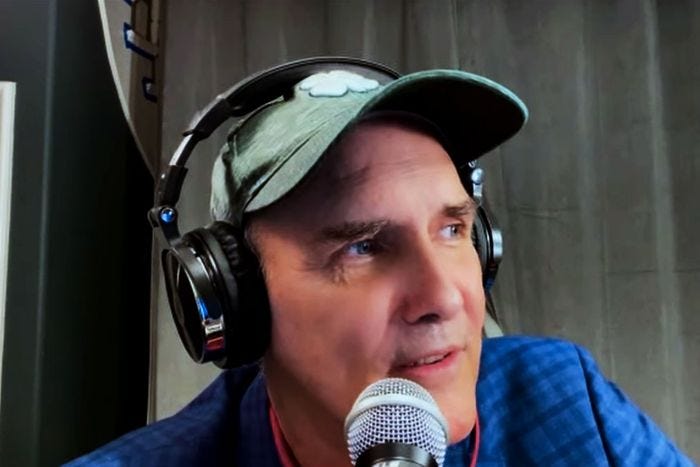
I think of him when I think about a bit on Down Syndrome from Norm Macdonald’s posthumously released new Netflix special (cleverly titled “Nothing Special”). I heard a more provocative version of the bit in a bootlegged performance somewhere, but it still had a bite to it in this version. Norm uses the phrase “mentally retarded,” then discusses the current taboo around it, even though it wasn’t always considered an insult. I can confirm this from my own memory of hearing my grandparents use the phrase. So far from being bigoted towards the mentally handicapped, they had dealt with Down Syndrome in the family and had gone forward with the adoption of my mother despite a mistaken early scare that she had it. As Norm says, “retarded” simply meant that your mind was in a state of arrested development. It wasn’t a slur in essence, though it came to be used that way.
As the bit progresses, Norm turns the tables on the speech police in his usual subtly savage way. Which is more bigoted, really? To use the word “retard,” or to make a virtue-signaling show of avoiding it while treating Down Syndrome people with the soft bigotry of condescension? “I love people with Down Syndrome,” Norm says with a twinkle. “I wish I had Down Syndrome. And I’ll tell you why, ‘cos they’re happy. You know what I mean? They’re happy! What’s wrong with that? Man, I wish I was happy, you know?” Norm talks about a “friend” with the condition, who may or may not exist (this is Norm), but either way functions as an archetype—the archetype of the nicest person you have ever met who may never have read a book, to quote Ian McEwan. “I was happy when I was with my friend, I’ll tell you that. I would love to have a friend right now. ‘Cos how often are you happy? You ever be happy?” Norm’s voice catches in a short, sharp laugh. “It happens once in a while, you know?”
He suggests the moment you wake up might be a good candidate. That might be a happy moment, when you think about how glad you are that you bought that tempurpedic pillow (“best purchase I ever made!”) But then the light bleeds in, and life bleeds in, and it “gets all over you like a cobweb, you’re like goddamn! It’s not fun.” And maybe you look at yourself in the mirror and you think “Aah, good God! What’s become of me? I’m gonna go back to bed and cover myself up!” In moments like these, Norm thinks how nice it would be to have a mentally retarded friend who could look in the mirror with him and say, “I like bananas!” And then Norm would turn to him and say, “Goddamn, I never looked at it that way. I like bananas too!” And then the retarded friend would note, “They’re YELLOW!” (A running bit in this special is that Norm’s favorite color is yellow.) And Norm would say, “Damn, you’re right, they are yellow. Ha! What say you and me go and buy a yellow banana?”
Yes, of course Norm is aware of the meme that “Down Syndrome people aren’t happy all the time,” but that’s not his point. His point is that he has never seen a cynical person with Down Syndrome. Such a person might not be perpetually in the mood for a banana, but have you ever seen one go, “Ah, f@*& bananas, they’re yellow, I don’t care. Who cares”? You haven’t, have you? Norm didn’t think so.
He imagines the PC police, so very tolerant and understanding, regarding the “Down Syndrome people” at enough of a distance that they can shake their heads sadly without being noticed. “And you know the saddest part of all? There’s no cure! They’ll probably die happy.”
We will never really know if Norm died happy. We can only hope. And we can only be grateful that he said the quiet part out loud, for all our souls’ sake.
This is the tenderest appreciation of the man that I have yet read. Thank you.