

I rarely see movies even once in the theater, let alone twice. I have now seen Project Hail Mary twice, and with the directors’ decision to release a TheaterEars commentary track (just the latest in a string of brilliant marketing decisions), I am even considering a return for thirds. Having gone into the movie blind before reading the original Andy Weir novel, I then purchased the audiobook, another thing I almost never do, and was bedazzled beginning to end by Ray Porter’s performance. And of course, I also have the book on Kindle. I have now spent more money on more versions of this one story than I have on any other one story I can recall at the moment. It is that engrossing.
The novel is hard sci-fi made easily digestible by being such a ripping good yarn, as the Brits would say. The movie, back in IMAX this weekend by popular demand, is old-school exuberant blockbuster filmmaking at its best, a visual and sonic feast whose cinematic magic is grounded in practical effects. The most magical of these effects is our hero’s alien sidekick, who has to be one of the best alien characters in all sci-fi. To film their scenes, Ryan Gosling physically interacted on physical sets every day with puppeteer James Ortiz, who not only handled but voiced the lovable creature in the venerable tradition of great puppeteers past like Frank Oz. Fans of the book complained that the alien’s reveal in the movie trailer was kind of a spoiler, but now that good old Rocky is everywhere, I feel okay acknowledging his existence (though I’ll be issuing a Major Spoiler Warning later in this piece for all who require it).
While Rocky has some qualities of a loyal pet, he is in fact what C. S. Lewis in his Ransom Trilogy would have called hnau—a fully rational creature, complete with his own intricate language, culture, and grand Quest, which turns out to be the same Quest on which Dr. Ryland Grace has found himself embarked. Through their combined heroically nerdy efforts, they must race to avert planetary apocalypse by thwarting a star-eating parasite. Their galactic buddy comedy is somehow managing to rescue heartfelt, wholesome masculine friendship from the cultural gutter, despite the modest limitation that one of the “men” is a faceless rock spider. Key to its success is the fact that beneath the comedy runs an undercurrent of deep melancholy. The story has been called optimistic, but its optimism has an inescapably tragic tinge, for it is the story of a man without a planet.
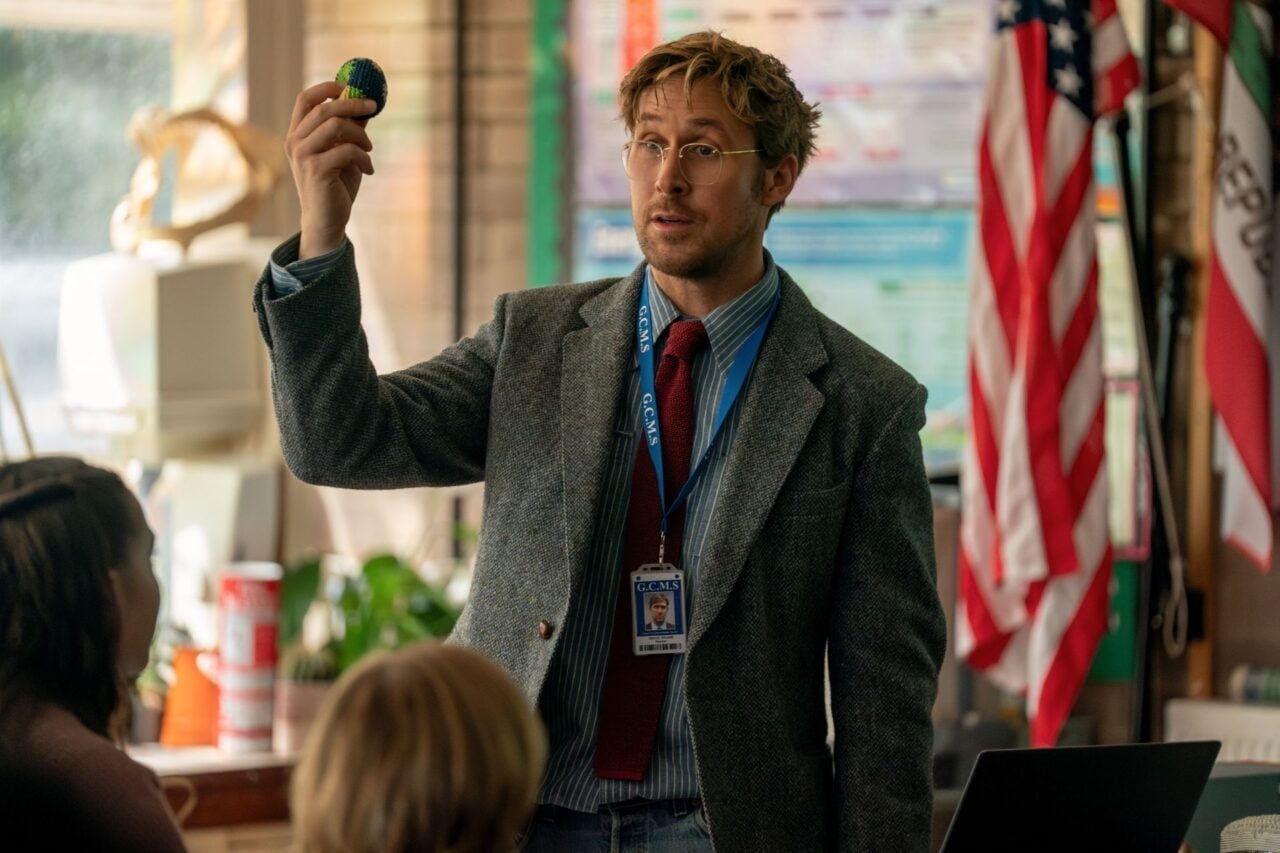
We meet Dr. Grace first as a terrified, apparently untrained astronaut who has woken up on a spaceship light-years away from Earth unable to recall his own name, with no companions except two long-dead fellow crewmembers and a robot. Through flashbacks, he slowly remembers the sweetly shy, overqualified middle-school science teacher he used to be before his particular research skills were abruptly…required. His life was happy enough then, if a bit isolated. As he goes through his crew’s kits in search of clues, he finds pictures of the dead astronauts with their families, but in his own kit there is only one picture of himself, alone. How exactly he got from there to here is a mystery whose full payoff will not be revealed for some time.
Recently, Andy Weir let his true feelings be known about the latest iterations of Star Trek and how far it’s fallen from its first conception. It is clear that he aspires to craft sci-fi in the spirit of the best Trek—funny but not too wacky, serious but not too preachy, and above all, full of heart. There was also in the best old Trek a willingness to grapple with painful moral conundrums, sometimes towards conclusions I didn’t agree with, but framed compellingly. The classic episode “City On the Edge of Forever” stands out, in which Captain Kirk holds the fate of a single innocent woman in one hand and the rest of the world’s fate in the other. For reasons I’ll be explicitly spoiling in a moment, that episode particularly came back to mind as I watched/read Project Hail Mary. The fascinating thing is that while on one level the film is a faithful adaptation, on another level it diverges so much that book and film appear to answer the story’s moral conundrum in nearly opposite ways. I find the reasons for this divergence understandable, but I am still forced to conclude that while the book gets my unreserved recommendation, the movie for all its ten thousand charms is ultimately built on a lie.
MAJOR SPOILERS NOW FOLLOW! YOU HAVE BEEN WARNED! COME BACK WHEN YOU HAVE READ, OR WATCHED, OR BOTH!
The story’s third major character, a Dutchwoman suggestively named Eva Stratt, is the person into whose hands all global authority has been delivered in this crisis. By the same token, it is her hands that will bear the damned spot of whatever blood is shed along the way. Her original book incarnation is, in Weir’s words, “an ice queen on heels,” setting about her tasks with a blood-chilling Germanic efficiency. If the Sahara Desert must be paved, it is done. If Antarctica must be nuked, she will make it so. And if a few brave souls must be sent to a corner of the universe so remote there will be no return journey, on a research mission whose chances of success are near-zero, she will unflinchingly orchestrate their desperate suicides for the greater good. Hence the name of the ship, and the project: Hail Mary. But no one will comfort Eve.
Stratt’s film incarnation, as played by the luminous Sandra Hüller, appears as a character with the same name who feels like a different woman. Where book Stratt is constantly, brutally reminding Dr. Grace that she has recruited him solely as a means to the end of saving the planet, movie Stratt nurtures him with a maternal warmth that occasionally edges into something more. This is felt most intensely in a film-exclusive scene where she delivers a karaoke performance that feels personally directed to Grace. Because Hüller and Ryan Gosling share the gift of being able to speak volumes with their eyes alone, the original cut of the scene was significantly trimmed in an attempt to tone down their unspoken chemistry. Volumes are spoken anyway:
In the end, for reasons that are explained far better in the book than the film, circumstances conspire to suddenly make Dr. Grace Stratt’s top candidate for the doomed spaceship’s science expert. For a few hours, she lets Grace think that he has a choice in the matter. When he comes back with a “No,” he discovers that she was lying. Book Stratt does this with barely a twinge, explaining precisely how she plans to trick the “annoyingly honorable” ship’s captain into believing Grace volunteered. In her final conversation with Grace, at the end of which he tells her to “go to hell,” she assures him, “Oh, I will.”
By contrast, movie Stratt seals his fate with obvious agony, watching out the window through tears as men chase him down and forcibly sedate him. “This may feel like betraying you,” she says, “but it’s actually me believing in you.” She is backed up by a government agent named Carl, who Grace thought was his best friend, and whose name is the last word he speaks on Earth. “You know who you are,” Carl says encouragingly. “You’re gonna do great.” When Dr. Grace emerges from his induced coma, we see the words “GOOD LUCK!” in sharpie on his bag.
This twist has functioned like a Rorschach blot, with opinions about equally split as to whether Stratt is making an excruciating but righteous choice or a pernicious choice. It seems clear that the filmmakers want to spin it as the former, while Weir himself meant it to be the latter. He’s said that at first he vigorously protested the karaoke scene because it didn’t fit book Stratt’s character, but this suggests a failure to grasp how movie Stratt was being rewritten top to bottom from the start. Had movie Stratt hewed more closely to book Stratt, the creators would have had an explicitly darker product on their hands, much harder to market to the whole-family audiences they wanted to court. It’s dark enough as it is, but spoonfuls of sugar are being added to try to make the medicine go down. Book Stratt in one sense “believes in” Grace, but with no trace of love. Movie Stratt, we are meant to think, really does love him. It’s just that love sometimes looks like forcing someone to sacrifice himself for the greater good. We might need someone else to believe in us before we can believe in ourselves. Or something.
Disturbingly, I’ve found that even some Christians are falling into this ethical trap as they discuss the story around the water cooler. Many basic distinctions are being missed in the arguments I see, like the difference between being ordered to make a calculated sacrificial risk and being ordered to commit suicide. (The book really drives home the creepiness of the fact that the astronauts are being offered their choice of suicide methods as if from a menu, so they don’t just have to starve slowly in space.) Someone shared a famous clip from the submarine thriller U-571 in which a formidable young Matthew McConaughey sends an even younger sailor to do a highly dangerous task only he can physically attempt. The boy panics, and the officer orders him with a pained, loving harshness to “Do your job, sailor!” Predictably, the task proves fatal, and though the ship is saved, the officer will be haunted forever. It’s a brutal scene, but disanalogous to the setup of Project Hail Mary. Better would be an example of an officer giving not merely dangerous but unequivocally suicidal orders, of which there are plenty of examples in military history, which of course does not make them ethical.
As I was discussing this with a friend who shared my intuition, he brought up the COVID crisis, and it flicked on a lightbulb in my mind. In that real-world scenario, as in this story, agents with far too much unchecked power took it upon themselves to force people into certain choices against their will, in the name of the “greater good,” against an ominous impersonal invader, because they elevated the priority of not dying from the virus above all else. And there, as here, I was startled by how many Christians matter-of-factly accepted this. Aside from the absolute wrongness of the choice, there is a hubristic failure to consider other factors. It’s left especially hand-wavy how movie Stratt is so sure that movie Grace—panicky, frightened, lacking astronaut training—could even complete the mission (never mind the actual eventuality that an accident wipes out the rest of the crew, forcing him to learn things he wasn’t supposed to have to learn).
Ironically, Stratt’s position is steelmanned better in the book, but as part of elevating the entire debate into a serious, full-bodied ethical clash. Grace makes the entirely reasonable case that even if against all odds the mission succeeds, Earth is looking at a brutal next 20-odd years, years for which a rising generation will have to be trained up. So why should he not stay in the classroom where he belongs, with kids he loves like the kids he never had? And in the likely event that no solution was found, why shouldn’t he be allowed to die comforting them? The argument is reminiscent of the case for allowing people to gather, touch, and embrace each other in defiance of the virus.
Someone pushing back on my take here was astonished that I favored Grace’s “just passively accepting death” on Earth as the sun dies, versus making some effort however insane to save it. It struck me that this person had an impoverished view of what it means to die. Death, from a Christian perspective, is not merely passive but active. This is perfectly captured in the great Catholic novel A Canticle for Leibowitz, in which an abbot is left behind to perish in the last nuclear holocaust while one monk is chosen to lead a remnant of the Church into space. The majority of Earth’s people will perish, but those Christians like the brave abbot who remain at their earthly posts while the world burns are no less active than those blasting off in a rocket. It is understood that they, too, have a calling to fulfil. Meanwhile, the scene where the young monk is chosen to lead the space-bound flock feels like a photo-negative of the scene where Grace receives his grim orders. Like Grace, the monk is a timid man daunted by the task before him, asking for a few hours to think it over. But unlike Grace, he is being sent to his life, not to his death.
Of course, Stratt has no way of knowing that Grace will meet his salvation, in the form of a pure-hearted alien whose ethical system is innocently free of consequentialism. From the moment they first meet and begin the thrilling process of learning each other’s languages, Rocky sees Grace as end in himself, not a means to an end. He has also suffered the loss of his crew, except he has spent many more lonely years in space without them (his people, Eridians, are a long-lived species). When Grace miraculously appears before his “eyes” which aren’t really eyes, because he “sees” by echolocation, he immediately loves the friendly, lonely human. He doesn't know how to do otherwise than love the person before him. And neither does Grace. And so friendship is born at that moment when they each say, “What? You too? I thought I was the only one!”
All of this, the film conveys beautifully. We are certainly meant to care deeply for Grace, to root at every turn for his survival and flourishing as Rocky carries him to heights he never dreamed of. But the film fails to understand that the Way of Rocky cannot be forced into a tenderly forgiving coexistence with the way of Stratt. In the book, her self-damning “Oh, I will” is understood to be final. Book Grace reflects bitterly that she was “right,” insofar as her ruthless game-theoretic calculations were not wrong. She was right that there was no one better qualified. She was right that he would know what to do once he was there. And she was right that even when the final knife-twist flashed back to him, he would be so invested, and so fundamentally decent, that he wouldn’t withhold whatever discoveries he’d made. But none of these things make her, in the fullest moral sense of the word, right.
This is sealed in the book’s choice to have Rocky deliver the triumphant news that Grace’s dispatched research landed safely, and our Sun has been restored. The deeply emotional moment is theirs to celebrate together. In the film, it is treated as a moment between Grace and Stratt, albeit asynchronous, as she bursts into tears while watching his breakthrough dispatches and prepares her team to get to work. That is not a moment book Stratt has earned, and so it’s reserved for those who have.
Of course, the great paradox of the story is that without Stratt’s betrayal, Grace would never have met Rocky. The biblically-flavored catch-phrases write themselves. “You meant evil against me, but Rocky meant it for good.” “Rocky works all things together for good.” “But Rocky!”
In the end, as Grace takes his place in another classroom, on another planet, clapping his hands in the way he does when he is brimming over with joy, he appears as a man stepping into his afterlife. This is actually felt more strongly in the film than in the book, where Grace is content but older, wearier, touched with a little more melancholy as he considers his last decades on this planet that can never really be his home. In the film, Grace’s biodome appears much more paradisal and earthlike, even including a beach with foamy waves. In the words of the uncannily chosen closing credits song, he feels better, so much better, since he laid his burdens down.
I went last week with moderate expectations and WOW. It got started slow and I was afraid my expectations were too high. My wife was almost ready to leave as it was looking like a rather so so sci-fi. But it took off and captured your heart. Reading your review and hearing a few other comments I think i must get the book for the additional color it offers.
Hey - and have you seen "A Great Awakening"? About the intercourse between B Franklin and Rev G Whitefield. It is really amazing. So well filmed and written. You have to see it.
On your recommendation of this film I took the wife to go see it and we were not disappointed. Once I had seen the movie I finished your review and it is a bit insidious the way that they got the utilitarian medicine down with the sugar of a genuinely heartwarming film and played it off as forced soul building instead of forced suicide (that only failed by the sheer grace of God). But it's still a great movie.