

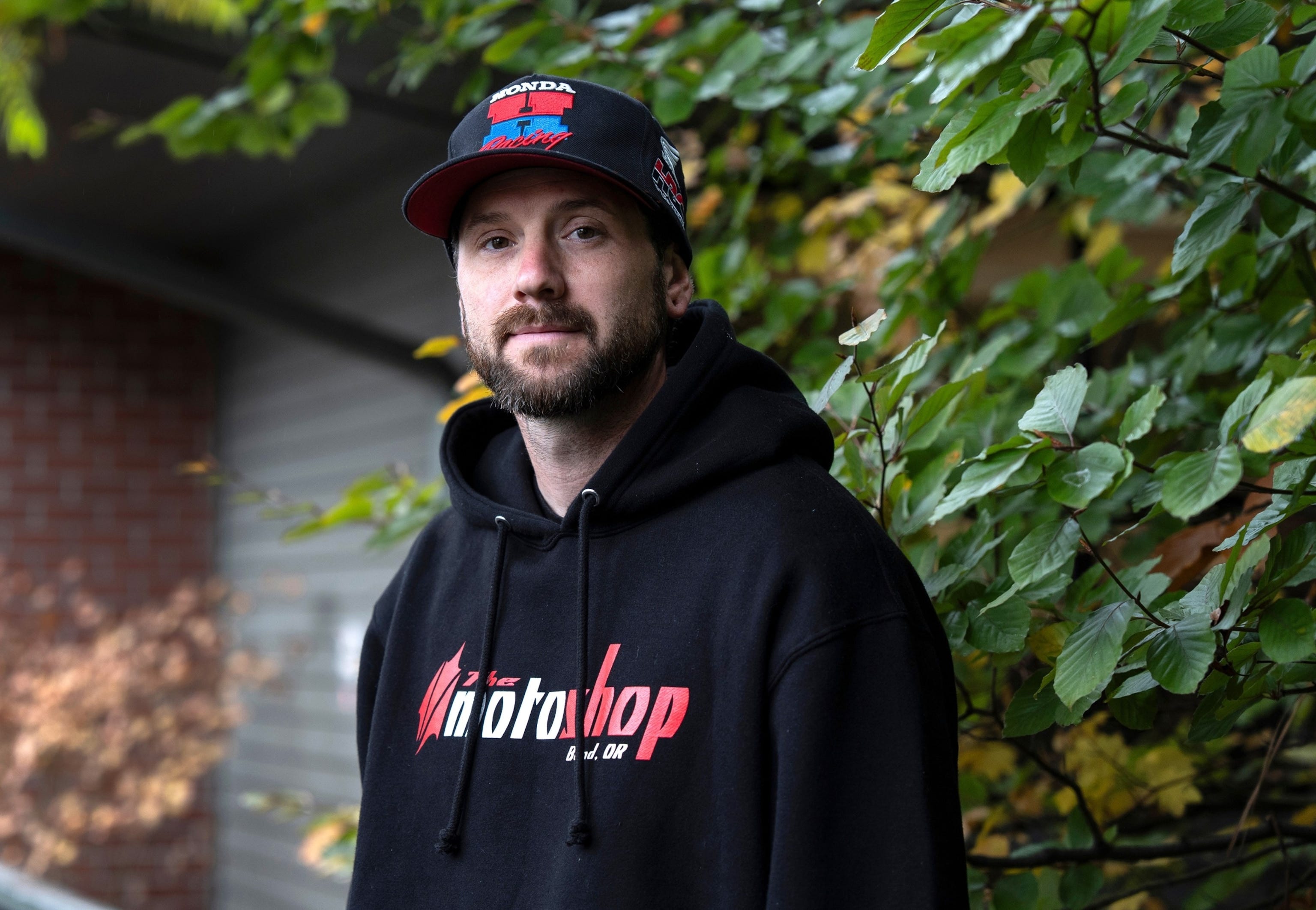
“I’ve always wanted to change the world, but I’ve felt small. I’m just a carpenter from Bend, Oregon.”
Nobody knew Kaylub Giamanco’s name until two weeks ago, when he entered an elementary-school classroom full of children pleading for their lives and killed the boy who would have killed them. A female teacher was already ferociously launching herself at the gunman, wrestling with the weapon. There was a window, a fraction of a second. Giamanco stepped forward and took his shot. Then he took two more. Then it was over.
The teacher has chosen to keep her name private, but Giamanco decided he needed to share his story publicly. And what a remarkable story it is, told in the most unassuming way possible. Pictures of the hero show him as a tattoo-sleeved grill dad, an avid outdoorsman, husband and father of two little girls who were at that school that day. A simple kind of man, living a simple kind of life. The only reason he happened to be driving past the school in those crucial moments was because he’d decided to drive home from work and share a lunch break with his wife. That was when he saw the boy with the shotgun in the parking lot. The dispatcher on the other end of his 911 call began asking questions per protocol, but there was no time to answer them. As he army-crawled his way to a shot-out window, he could hear the children crying, in the special-needs classroom the shooter had specifically targeted. The thought came to him, “This is probably going to be the last thing I ever do.”
Giamanco was moving like a soldier, even though he has never served in the military. In his work as a carpenter, he had built a shooting range for some veterans who compensated him with hands-on training, which complemented and enhanced what his grandfather had already taught him about how to handle firearms. His first piece was a shotgun his grandfather bought for him at age 7. They would go hunting for birds in the mountains together. Later, they would co-lead gun safety classes for kids, along with hunting and survival strategies. Their bond grew tighter than ever when Giamanco’s father abandoned the family. He was only 15, but he was the oldest, and he knew the man he needed to become.
Would the shooter have become a different young man, if things had been different? If his parents had been present, if they’d been better? Giamanco wonders. Since the shooting, we have learned that 911 dispatch received no fewer than 52 service calls associated with the boy’s home between March 2020 and October 2026. Runaway juvenile, suicidal subject, domestic dispute, welfare checks. And for his mother, 37 documented encounters with Bend Police since 2013. The boy had attended the same school he attacked, placed in that same special-needs classroom, a child with “significant behavioral and social challenges.” Why his mother chose to put a shotgun in his hands at age 16, we will never know.
When Giamanco called his mother immediately after taking his shots, he began to break down. She assured him that he’d done the right thing, that he was a hero. But he still has nightmares. When he tries to explain to the journalist, words fail. “I can’t tell you what it feels like to take a life.”
A strange and dark parallel, but as I heard him recount this phone call, my mind went back to the terrorist on October 7 who called his mother to tell her, in delirious excitement, that he had gunned down a Jewish family. He asked her to put his father on the line too. Together, they celebrated. And here was Kaylub Giamanco, having killed in the most righteous, heroic way you could ever kill a man, and even then his emotion was not celebration but sorrow. Not only sorrow for the lives he couldn’t save, but for the life he had taken.
The discourse around mass shootings tends to follow a drearily predictable cycle, punctuated by the usual hysterical squealing from the usual suspects who keep repeating that “IT’S THE F****ING GUNS!” This discourse has been no exception. Never mind that Oregon has some of the most blue-state gun laws in the country. Never mind that one only has to set the life stories of Giamanco and the shooter side by side to see that it is quite obviously not “the f***ing guns.” Not that Giamanco himself, an independent voter, is looking for a political fight. Quite the opposite. “I teach my children that we love, we accept everybody,” he said when asked to comment on the broader discourse. But he also intends to teach his daughters, 5 and 10, how to use a gun.
The iconic line from Jack Schaefer’s Shane comes to mind: “A gun is a tool, Marian; no better or no worse than any other tool: an axe, a shovel or anything. A gun is as good or as bad as the man using it.” Yet Shane is also a story with much to say about the toll violence takes on a man’s psyche. The film is a lesser copy of the book, which I consider essential American canon reading, and which captures its titular hero’s inner torment far better than Alan Ladd could play it. In one scene, a hot-headed young man who has fallen in with the wrong crowd decides to pick a saloon fight with Shane. A seasoned barehand fighter, he dispatches the boy quickly, but it cuts him to the heart. With infinite tenderness, he picks the young man up and starts wiping the blood from his face, instructing the men in the bar to “take right good care of him.” To the boy’s unconscious ears, he says, “There’s only one thing really wrong with you. You’re young. That’s the one thing time can always cure.” But for the pain Shane carries in his own soul, he finds no cure.
Yet pacifists will not find that Shane has been written for them. Even as it acknowledges Shane’s torment, it still finds beauty in the action of masculine violence— the brutal grace of the bare-knuckle brawl, the lightning swiftness of the draw. We see Shane through the hero-worshipping eyes of the adolescent boy who comes to love him, so intensely that in our degraded era his love would no doubt be read through a “queer” lens. Every movement of the man is a marvel to him, a pattern he longs to copy. To his dying day, he will remember “the power and grace of a coordinate force beautiful beyond comprehension.” He will see “the man and the tool, a good man and a good tool, doing what had to be done.”
Last year, a policeman visited the church I attended at the time, a humble little Presbyterian church composed of a handful of regulars in a small building. He gave a presentation on active shooter training, playing some video and taking many questions. At one point, he did a little role-playing, pretending to charge into the congregation and letting one of our elders try to wrestle his weapon away (his first instinct was to force the gun up, the policeman suggested forcing it down instead). When the Uvalde shooting came up, a cloud passed over his face, and he minced no words.
The elder’s son, a constantly talkative, affectionate young boy on the autism spectrum, listened to the presentation with rapt attention, first to raise his hand and answer every question. When we got to the “run, hide, fight” section, the officer spoke solemnly about that moment when “fight” may be the only choice. “I would!” the boy declared loudly. “I’d fight him!”
Kaylub Giamanco and his family have been staying in temporary hotel and rental spaces since the shooting. The school is visible from their house. It’s too painful, too soon. They play board games to distract themselves. They hold each other close.
“My 5-year-old probably a hundred times a day comes up to me and just hugs me and says, ‘I love you, Daddy,’” he says. “And I hug her, I pick her up, and squeeze her as hard as I can. I say, ‘I love you too. You’re my world.’”
AMEN.
Thank you, Bethel. Bend was our home for over a decade before we returned to our home in CA. My best friend there was in her truck waiting for someone when she heard the gunfire, got her own gun out of the glove compartment. She also knew the eleven-year-old who died and knew his father well. That family is contemplating leaving Bend. Another friend started a GoFund drive for the family to escape Bend for awhile. My former city home is in deep mourning. It remains surreal for me. Thank you for bringing attention to this hero, this city, this abdication of appropriate responses to the shooter and his family for years. A former therapist, I shudder at the PTSD of so many people as a result of this horror. Thank you again for paying attention to this nightmare, allowing us to feel a few things that tug at our hearts, souls, minds and spirits.