

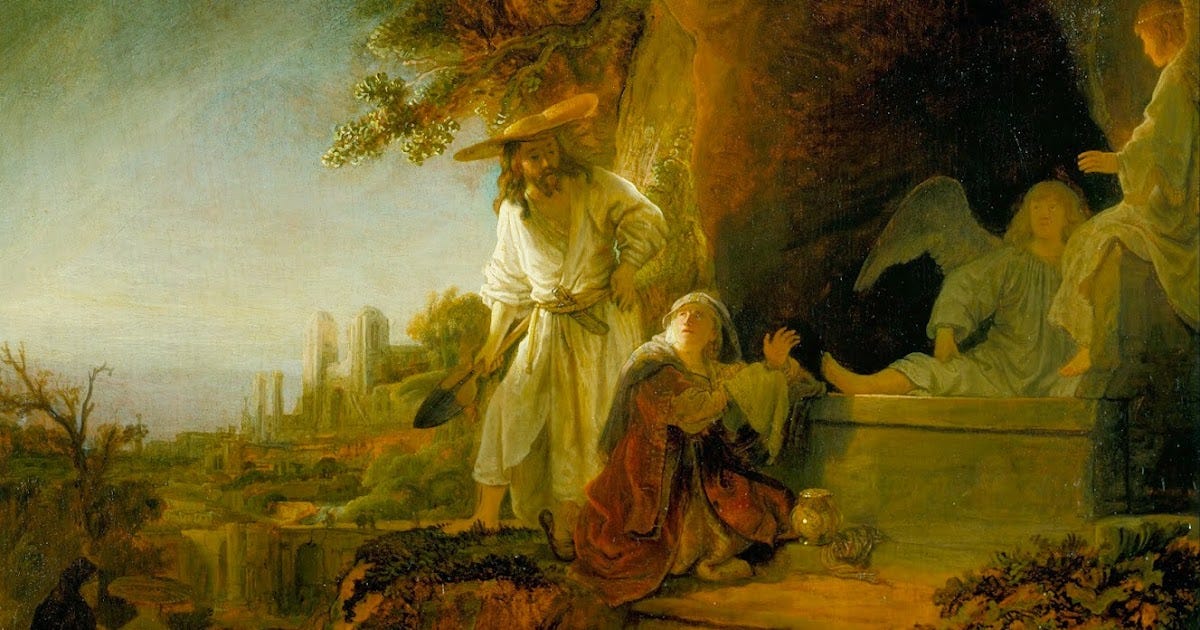
Happy Easter to all my readers! For those new to the Stack, you can enjoy older Easter reflections here. As always, thank you so much for reading.
Two summers ago, I had the chance to spend a week in Europe connecting with old friends and making some new ones. We enjoyed loosely structured conversations around a plethora of topics, everyone bringing his own distinct perspective. A number of us were Christians of an evangelical stripe, but some weren’t, which meant there was never a dull moment. Some of them were Jewish, and the events of the previous October were heavy on their minds. One Israeli friend, a Messianic Jew, wore a yellow ribbon pin. Before giving a brief talk, he said people had been asking him how he was doing, and he pointed to the pin and said bluntly, “Not well.” Under the Florence sun, we would all sit and chat and walk around a garden paradise in twos or threes, lifting our eyes to the hills, talking of wars and rumors of wars.
One scientist was devoting his constant research energy to the problem of how (or whether) we can save the world from apocalypse. To his way of thinking, the Christians were altogether too resigned to the end of everything, too ready to give up and accept it without a fight. If the rest of us wanted to sit around waiting for the apocalyptic tsunami, that was fine. Not him. He had too much European Jew in him, he liked to say. He told a joke about world leaders giving their last speeches as the end drew nigh. The American President and the British Prime Minister say some noble, flowery words about going down bravely, wishing everyone Godspeed, saying God bless this great nation, and so on and so forth. The Israeli Prime Minister stands up and simply says, “You all have 27 minutes to learn how to live underwater.”
Recently Benjamin Netanyahu found himself unexpectedly in the middle of an Internet discourse over a speech in which he hat-tipped Will and Ariel Durant on Genghis Khan and Jesus. In their book Lessons of History, the Durants describe history as “at bottom a natural selection of the fittest individuals and groups in a struggle wherein goodness receives no favors.” This is part of their extended narrative of the decline of religious faith in the West, whose leaders “assured their followers that the good spirit would win in the end.” But alas, they conclude, “the universe has no prejudice in favor of Christ as against Genghis Khan.” Netanyahu underscored this not with the goal of patronizing Jesus, but of justifying the constant vigilantly warlike ways of Israel to the rest of the world. Israel, along with all of the world’s democracies, has “no choice” but to “oppose their enemies in time, while there’s still time.” Otherwise, per the Durants, there is nothing to stop evil from overcoming good, like it has so many times before. Evil prospers when good men do nothing.
Of course, as soon as the clip escaped containment on Twitter, everyone took turns hearing what they wanted to hear. Netanyahu attempted to issue an apology and clarification, but such things rarely change minds. I understood and sympathized with what he meant. Still, I watched Christian reactions and Jewish counterreactions with great interest. Jewish Twitter had a right to be annoyed with bad Christian takes, but I also detected some of that same general exasperation I detected from the scientist who’s always thinking about the apocalypse, the idea that Christians are just constitutionally incapable of getting Jews. The history of the Jewish people has been a history of repeatedly managing not to die. And now that they have built themselves into a world power, they see themselves not only as the last best hope for their own people, but for all of civilization. They are saving the world right here, right now. What exactly are Christians doing, they’d like to know? Singing songs about flying away to be with Jesus by and by? What kind of luxury belief is that?
We answer that this belief has sustained Christians down the ages through all manner of circumstances—through plague, through war, through famine, through grinding poverty, through sorrows beyond human naming. Indeed, it is those who live least in luxury who are often most unshakably rooted in it. It was in the assurance of that hope that humble working-class Christians like Corrie ten Boom’s family, with little to share except their home, faced death to protect Jews in the Holocaust. And for the first followers of Christ, it was the assurance of what their own eyes had seen, what their own hands had handled, that sustained them through lives of voluntarily undertaken hardship and humiliation, in and out of prison, perpetually poor, perpetually expendable to the ruling authorities.
We answer as well that we have failed to understand Jesus if we understand him as merely a “good man.” It was not for telling us all to “be kind” that he was sentenced to death, but for making himself equal with God. In him alone did he say we would find forgiveness of sins. In him alone did he say we would have life eternal. For however ingenious we may be, however long we may outwit and outrun death, though we plumb the depths of the ocean, though we build a spaceship and blast off in search of a new world to colonize, in Adam we will all die. But in Christ we will be raised incorruptible.
This hope is ours, but the gospel of Christ, the great good news, is that it may be yours as well.
My Messianic Jewish friend, the one who wore the yellow ribbon and was not doing well, is fond of bringing up Jesus with great frequency, even in contexts where it’s implied that one should try to make one’s points while mostly avoiding Jesus, the Bible, etc. We were in such a context once, but as the conversation had turned again to the end of all things, he couldn’t help himself. “I know I’m not ‘supposed’ to do this,” he said, adjusting his glasses and pulling out his phone, “but I’m gonna do it anyway.” And with a firm voice, he began to read from the Book of Revelation:
Then I saw a new heaven and a new earth; for the first heaven and the first earth passed away, and there is no longer any sea. And I saw the holy city, new Jerusalem, coming down out of heaven from God, prepared as a bride adorned for her husband. And I heard a loud voice from the throne, saying, “Behold, the tabernacle of God is among the people, and He will dwell among them, and they shall be His people, and God Himself will be among them, and He will wipe away every tear from their eyes; and there will no longer be any death; there will no longer be any mourning, or crying, or pain; the first things have passed away.” And He who sits on the throne said, “Behold, I am making all things new.”
When the choice comes down to Christian fatalism or practical deism, I can only live by the latter. I might even guess that living by the latter is how the former is accomplished. Maybe.
https://youtu.be/XIzN6Z8BJOI?si=dSVapjFxWPW1MfGP