

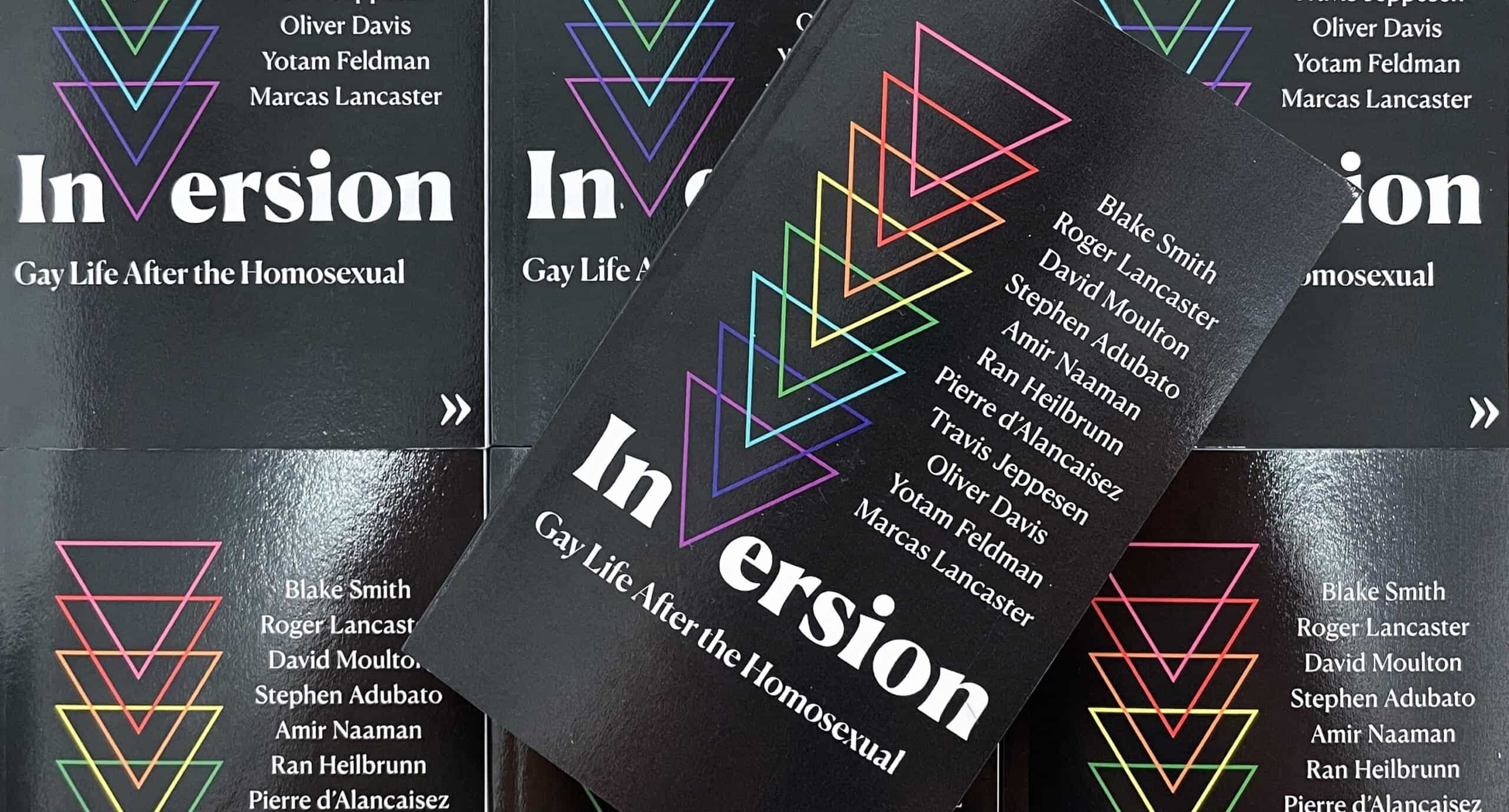
Gay men are in crisis, propose the editors of new essay collection Inversion: Gay Life After the Homosexual (available direct from publisher here). Not a crisis of oppression, but a crisis for the contributors far more terrifying: a crisis of boredom.
Once confident in their social role as taboo breakers and deviants on the margins of polite society, gay men today have won the right to perform normalcy. They are the recipients of unlimited political privilege, cultural pandering, and medical tech designed to save them from themselves. At the same time, they find themselves in a new caste system of sexual deviancy, expected to defer to identity groups ranked higher on the privilege ladder. Queer theory has gone mainstream, with the result that the rules of this caste system even contradict each other.
Where precisely does this leave yesterday’s deviants? What might an internal intervention into their crisis look like? Are they prepared for the fact that such an intervention might yield distinctly unflattering results? Does homosexuality have any intelligible purpose, any telos biological, cultural, or otherwise? Dare we ask if it ever did? Dare we ask if its current crisis might even “be constitutive of the thing itself”?
This is the terrain Inversion provocatively sets out to cover, though not towards a conservative goal per se. Although it allows some space for the straightforward traditional moral solution to the gay man’s conundrum, it is mostly shaped by voices rejecting it, yet more or less willing to admit the bleakness of the alternative. In this way, it functions as an attempt to reset the discourse to a dialogue primarily between honest trads and honest heathens.
Preliminary note #1: The editors provided me with a free review copy while aware that I am one of the aforementioned honest trads. A positive review was not required.
Preliminary note #2: This collection will be a useful resource for people interested in the recent history of ideas around homosexuality, as well as people interested in exploring actual diversity of thought around current cultural trends. Readers of mine who do academic, critical/journalistic, or even pastoral work in this realm might find it worth adding to their libraries. However, it is by design quite dark and at times quite graphic. So, caveat emptor.
There are a dozen essays in this collection, some of which held my attention better than others. (The final entry isn’t strictly an essay but more of a Proustian semi-autobiographical semi-fictional experiment. In my judgment, it doesn’t succeed as non-fiction or fiction, but then I’m not the target audience for Proust either.) Since space doesn’t permit a full treatment of all the collection’s themes and sub-themes, this review will focus on the three running threads that struck me as most salient: community, identity, and suffering.
Co-editor Pierre d’Alancaisez contributes “Freedom of Disassociation,” a charmingly morose reflection on gay “community,” or the lack thereof. It’s been observed many times that “LGBT community” is a contradiction in terms, but d’Alancaisez asserts that gay men are ill-constituted even for community with each other, narcissistic and irresponsible creatures that they are. This elevates the essay beyond yet another retread of LGB without the T talking points.
Also, like several pieces here, it’s a refreshing attack on the gay propaganda industrial complex which shields young gay men from having to confront their actual history. The supposed homophobic murder of Matthew Shepard, for example, is the quintessential gay myth that won’t die, even despite being debunked by a gay journalist. As the gaytekeepers openly admitted in their own words, Shepard was “too important, both as an individual and as a symbol,” with a “sacrosanct” place in American history. (I’ve written here about the interesting parallels between the gaytekeepers and a certain mainline form of Christianity that insists on the “higher truth” of Jesus’ life while treating the truth of the gospels as mere details.)
As a side note from my own research on intra-church “gay wars,” I recall once watching a Christian conference talk framed as “baby’s first gay history” for a naive young audience. The presenter put himself forward as a celibate gay Christian, but he was clearly a willing foot soldier in the pink propaganda war. Among other things, he held his listeners spellbound with the tale of a tragic arson incident in 1970s New Orleans which destroyed a gay hangout spot. The prime suspect turned out to be a disgruntled patron, a fact the presenter smoothly omitted. It is a sad fact that unapologetically practicing gay men are sometimes more honest about this history than men who fancy themselves standard-bearers (after some fashion, it’s not always clear) of a Christian sexual ethic. Hence the usefulness of work like this collection even for Christian readers.
My main criticism of d’Alancaisez here is that he presents his thesis as a rebuttal of Anita Bryant’s old line about how gays “recruit” (since they can’t reproduce). For this to be true, there would have to be such a meaningful concept as the gay “community,” and he argues (correctly) that no such concept exists. I respond that d’Alancaisez and Bryant are not contradictory but rather feeling different parts of the pink elephant. I remember once drawing the unpleasant attention of a mob outside a Planned Parenthood where a brave young woman was trying to share her story of gender detransition. This pathetic motley crew of young people apparently deemed it worth skipping work on a weekday for this “community” activity. They made a whole day of it too, complete with pizza and “music” blaring from a speaker. Perhaps the lesbians really hated the gay men who really hated the men in dresses, but it appeared at least in the moment that they were all having rather a good time together. Just because there is no honor among thieves does not mean they’re incapable of effectively pooling their resources towards the shared goal of stealing children’s innocence.
Other essays here do more exploration of the various political, cultural, or artistic ways gay men have formed “community” pockets over the decades, attempting to see if there’s anything at all meaningful to be salvaged beyond the one very obvious thing that, well, brings them together. A recurring theme is the unquestioned assumption—sometimes implicit, sometimes made explicit—that unfettered erotic energy is the lifeblood of the creative self. Through this lens, the traditional sexual ethic appears as a threat to drain away that lifeblood, leaving a drab, uninspired Puritan shell of oneself behind. Oh God, make me anything, but please don’t make me BORING.
This idea finds its most flamboyant expression in Travis Jeppesen’s lament for the lost transgressive art of “gay shame,” which among other things declares that having copious amounts of sex is a necessary precondition to being “any kind of artist.” But as a good friend of mine colorfully put it when we were discussing this, copious sex is only truly generative within the parameters of the Torah, and refraining from sex when appropriate is generative in its own right. The decline of Oscar Wilde is instructive here, as drawn in films like The Happy Prince, in which the literary icon pisses away his last days on booze and boys while inventing variations on the fiction that he’s completed and sold a new masterwork.
The contributors lodge protests in various keys of the contemporary notion of “gay identity,” preferring to shift the focus to the sexual act itself. Yet at least some of them still want to retain an idea that ongoingly practicing that act constitutes “being true to oneself,” as Roger Lancaster’s essay says in so many words. This insistence is curious given Lancaster’s equally confident assertion that gay identity “is not something that exists, a fixed, fast-frozen thing.”
In this context I find it interesting to note that gay provocateur Quentin Crisp, that most colorful icon of “being yourself, no matter what they say,” was known to say in his usual cheeky fashion that homosexuals are not “real people.” This is dramatized in the film An Englishman in New York, in a scene where a lesbian stands up to chide Crisp for this verbiage during one of his performances. She admonishes him to “be more careful,” and he agrees, but he maintains that “I do think of myself as artificial, as an invention.” Who was the true Quentin Crisp? It seemed that even Quentin Crisp didn’t know.
Young Israeli philosopher Ran Heilbrunn’s essay “Abolish Queer Theory!” proposes that queer theory and traditional sex moralism are two sides of the same coin, each “burdening” and functionally desexualizing the sexual act by “reading values and ideas into the sexual realm.” Au contraire, values do exist in the sexual realm whether we would like them to or not, making certain acts objectively sacred and others objectively perverse. But this follows from the inherent nature and telos of the sex organs, as opposed to those “values” conjured out of thin air in the precise shape of the queer theorist’s masturbatory fantasies. Heilbrunn also fails to understand Christianity as an incarnational religion, within which we are in fact designed to experience an intensification of physical pleasure when that pleasure is appropriately circumscribed. Indeed, despite all the stereotypes, actual Puritan literature is quite lustily sex-positive.
Still, Heilbrunn’s contribution retains academic and entertainment value as a spirited assault on postmodernism and all its pomps. Tracing the evolution of queer theory from its birth among the “screaming queens” of the 1970s to its present-day academic inanities, Heilbrunn diagnoses it as at root “a paranoid persecution complex.” The calls to “abolish” all societal norms and indeed society itself are an attempt to shift the blame for a sexuality “mired in jealousy, aggression, and obsession.” All of human culture becomes the scapegoat “for the undeniable pain and suffering of sexual non-conformity.” When leading queer theorist Michael Warner sets out to read his personal oppression into every civilizational document, he arrogantly casts himself “as Western culture’s eternal victim.”
Though Heilbrunn does not draw this connection, he touches here on the precise place where indeed all attempts to situate the gay rights movement in a genealogical straight line from Christianity will fail. For within Christianity, there is only one eternal Victim, and he is not Michael Warner.
Stephen Adubato’s essay “The Deception of Orientation Essentialism” stands out as the only contribution acknowledging the Christian case for celibacy, within the frame of Catholic natural law. Adubato lays his own traditionalist Catholic cards on the table upfront, though he pauses for a time-wasting side comment that the opposite view could be “reasonably” argued. But the piece on the whole is a welcome counterweight, and it reflects well in turn on the editors that they believed such was needed. Adubato puts the pastoral yet frank voice of Cardinal Ratzinger in conversation with Camille Paglia’s equally frank sex-realist hedonism, suggesting not only that they are each other’s proper opponents but that they are the only perspectives worth significant discourse bandwidth. Mushy middle-dwellers — from secular consumerist gays to progressive “Christian” gays — market themselves to “normies” by presenting gayness as a way of being while glossing over the sodomitic act. Neither Ratzinger nor Paglia will allow them off the hook so easily.
Nowhere has this deceptive marketing been more blatant (or more culturally successful) than in the AIDS history racket. In this collection’s spirit of exposing gay propaganda, Adubato rightly scorns the manipulative tactics of activist groups like ACT UP, which built their authoritarian brand on blaming every establishment for the epidemic except the gay establishment. (By contrast, Randy Shilts at least had the integrity to make an equal-opportunity anti-establishment case in And the Band Played On.) It was in fact the opposite of “hateful” for Cardinal O’Connor to preach celibacy, the one sure-fire way for gay men to spare themselves from the disease. But in order for the wheels of the pink propaganda machine to keep turning, he had to become the enemy. Figures like him were the answer to the question provocatively asked by another contributor to this collection, David Moulton: “If gays are the new Jews, who were the Nazis supposed to be?”
At the same time that they were insistently shutting out voices of spiritual authority, homosexuals demanded substitute salvation from the medical industrial complex. Though early treatments ironically proved worse than the disease, the PrEP drug would eventually emerge as the gay man’s escape from the consequences of risky sex. As the plague and its victims drift out of living memory, new generations live by the promise of modern medical tech that reality needn’t inhibit their self-actualization. Though not sharing Adubato’s traditionalist stance, Moulton does share his contempt for this paternalistic biopolitics—Big Brother keeping gay men at heel by promising to save them from themselves. His contribution “Towards a Gay Art of Suffering” connects his suspicion of this “utopian project” with the “endless biomedical interventions” thrust upon us during COVID.
Moulton develops his anti-utopian thesis from a literary angle, lambasting contemporary work that airbrushes out the sad griminess of “LGBT” life. He is especially unnerved by little children’s books that make gender transition appear fun and cute. At the same time, he too-generously forgives the people who write such books and stock them in libraries, supposing that they don’t intend to “exploit children sexually” but are simply too hasty to shield hypothetically gay children from pain. Whether the authors are sexually fixated on children or not, the conservative would argue this literature is designed to normalize that which is fundamentally abnormal, and as such it is corrupting little children’s natural intuitions (“A boy can’t marry another boy!”) And whether the children themselves are being viewed as potential “recruits” or potential “allies,” the point is to flood their plastic brains early and often with propaganda protesting too much that This Is Normal.
Moulton traces his own adolescent awakening through gay cult classic works like Jean Genet’s masturbatory prose poem Our Lady of the Flowers, which hardly conveyed the message that This Is Normal but seduced the sheltered Moulton by exoticizing sexual deviance. Genet wrote the autobiographical work in prison for “indecency,” constructing it as a series of stream-of-consciousness fantasies about the various wretched characters of his street life. Moulton correctly predicts the conservative assessment that this was simply a “snootier” form of literary seduction than today’s lowbrow offerings (a seduction that bore sad fruit in the phase of his own life when he was turning tricks on the streets of San Francisco to pay rent). It also must be said that merely being highbrow doesn’t make a work valuable even as art, and that a compulsive obsession with sex is counterproductive to artistic and moral goals alike.
But Moulton still wants to argue that Genet’s work, like the work of other favorite authors, retains the value of honesty about gay suffering. Even more provocatively, he proposes that Genet is “heeding Jesus’ call to love the least among us when he writes: ‘My loved ones will be those whom you would call ‘hoodlums of the worst sort.’” Genet “does Christianity one better,” even, because “he loves the most wretched not despite but because of their wretchedness.” Yet one cannot truly and completely love the wretched while loving the wretchedness that contains them in the prison of their own making (or inviting them into yours). Hence the well-worn cliché “Love the sinner, hate the sin,” which despite being a cliché is nonetheless conveying something importantly true. Genet’s “love” for the “hoodlums” is a possessive, rapacious simulacrum of love, a blend of pure objectification and gratification at finding souls who make him feel less isolated in his own wretchedness.
I initially mistyped the name of this essay as “towards an art of gay suffering,” an apt slip, as it is really the only kind of suffering in focus throughout Moulton’s piece. To the extent that art truthfully reflects sexual dysfunction, it does at least have the virtue of honesty over pure propaganda. But truly memorable “art of suffering” points to a suffering beyond the self-inflicted kind.
By way of a better example even from the shelves of relatively disposable gay lit, I would point to Andrew Holleran. In the epistolary framing prologue to Dancer From the Dance, the narrator somewhat channels Genet when he expresses his fascination with the “doomed queens” who drive their cars right off the cliff, the “fags who consider themselves worthless.” “It was those whom Christ befriended,” the character declares with feeling, “not the assholes in the ad agencies uptown who go to St. Kitts in February! Those people bore me to DEATH!”
But Holleran’s work is not solely preoccupied by their debauchery. It is also haunted by the call to take on the burden of actually meaningful suffering, in the real world outside the prison of endless self-pleasuring. The narrator’s Southern correspondent is a friend who has escaped New York, that metaphorical prison, and reflects on how leaving the gay scene behind has freed him to participate in self-giving acts like the care of a sick elderly Cuban woman. In her room, there is “LIFE, not the hothouse, artificial, desperate life we led up there in Gotham, but LIFE as it is in all its complexity and richness.”
Holleran would return to that image in The Beauty of Men, which juxtaposes the narrator’s empty nocturnal pursuits with days spent caring for his paralyzed mother. Though dispiriting, this participation in his mother’s innocent suffering is still the real stuff of real “LIFE.” Not that this guides the work to an especially hopeful conclusion—it is still a gay novel, after all.
But if there is to be a hopeful conclusion to the actual real-life narratives shaping this essay collection, it would be in the channeling of their suffering into an others-focused self-abnegation. This isn’t the prescription recommended by Unherd’s Jarryd Bartle, who ends his review with a patronizing exasperation that these guys can’t seem to just settle down with a boyfriend and stop being so damn depressed. A little “sunlight, cardio, and tender affection” should cure what’s ailing them, he predicts. But this is a brave new world, and like Huxley’s heroine they demand the right to be unhappy.
Pierre d’Alancaisez’s essay concludes that the gay man is best understood “freely disassociating from a community that he is no longer able to imagine, deserving neither pity nor rescue.” Indeed, none of us do, but they are offered anyway, and with them that Love which is joy and beauty, which we have sought in a thousand streets and for which we have wept and clawed our pillows.
“If gays are the new Jews, who were the Nazis supposed to be?”
We know who we are, and we understand the mischaracterization by which we are described that way.
Some of that mischaracterization might be our own fault. We have any number of really bad spokesmen speaking on our behalf. We rarely get to make the distinctions that might lead to a better understanding. We are repulsed by the LGBT "community". And their propaganda angers us. And sometimes we might strike back in what can be perceived as un-Christian ways. Especially when there is a big incentive to amplify such perceptions.
But Christians who draw a line -- the same line that the Bible draws -- aren't repulsed by homosexuality because we are Christian. We are repulsed by homosexuality because we are human. ChatGPT puts it succinctly: "From an evolutionary psychology and biological standpoint, these aversions are rooted in mechanisms designed to prevent inbreeding, mitigate disease spread, and protect social structures, though the scientific explanations for each differ significantly." It is human survival that causes the repulsion. Not religious belief. The "religious" belief leaves us broken-hearted and wishing for salvation from our fallen state. But the repulsion and the broken-heartedness are forever vying for primacy in the Christian mind.
And it isn't love to disregard a behavior's negative impact on individuals OR societies. It isn't love to live and let live. That doesn't determine a Christian' path in dealing with this issue. But it definitely draws the line.