

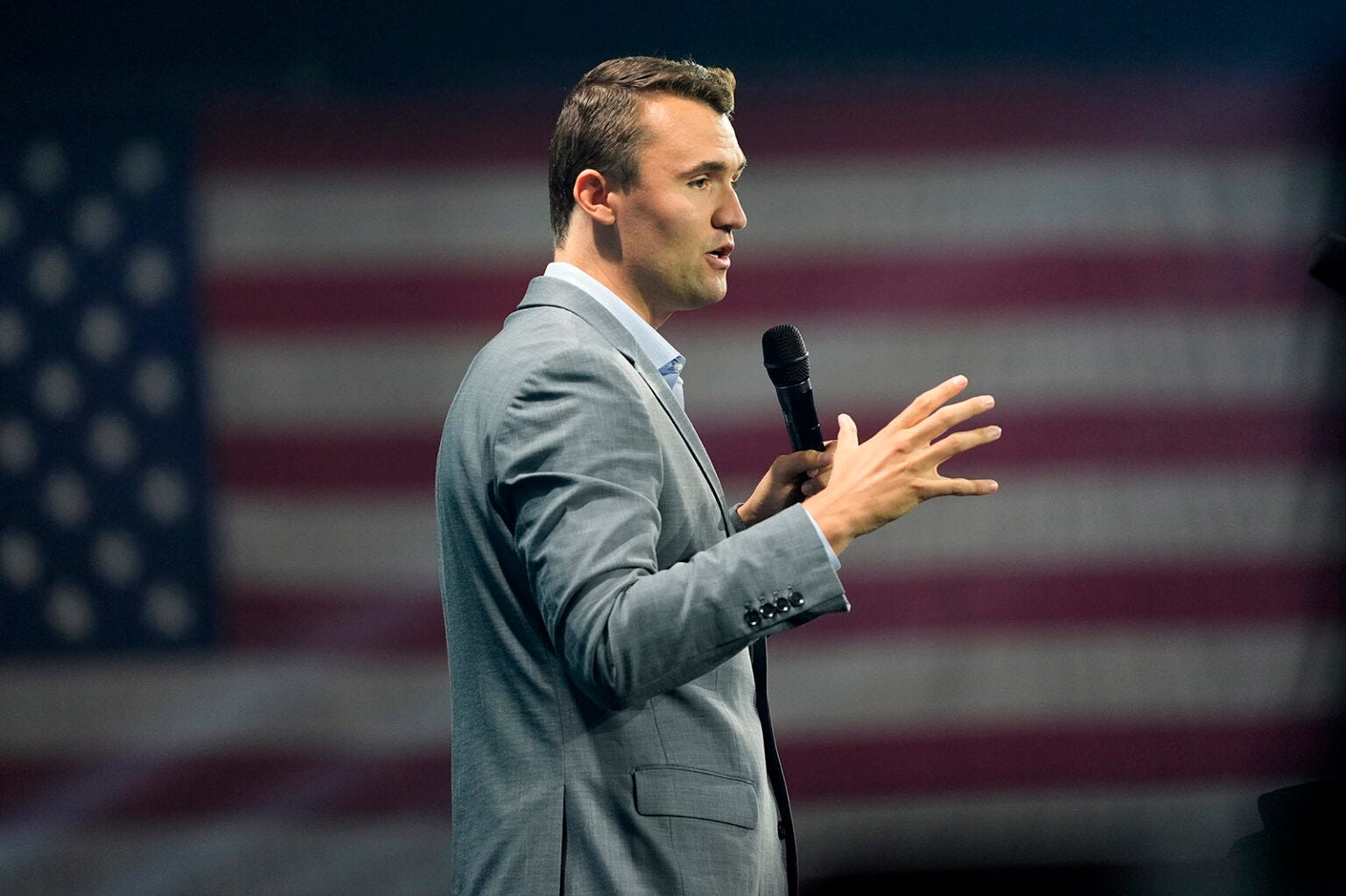
It’s been one year today since the public murder of Charlie Kirk, and I’ve spent the week unsure what to write about it, even though I knew I should write something.
As I wrote in my initial reaction piece last year, I didn’t follow Kirk much, except a little bit in the last months of his life when I started to pick up some viral clips from his campus events. I was struck by how well he handled these scenarios, improvising answers with no notes and the knowledge that everything was being recorded. It is not the sort of environment in which I would excel, but he seemed completely in his element. Everyone who knew him would say that he was. In the wake of September 11, Peggy Noonan quoted a friend who observed that everyone who died on that day died as who he was—from the man selfishly elbowing people out of the way to the man selflessly refusing to leave a colleague behind. Charlie Kirk died as who he was.
I somewhat reluctantly took part in a dialogue shortly afterwards with a theologian I’d never heard of before, who’d decided that Charlie Kirk’s death was mainly about him and his racial grievances as a “brown man” whose feelings were hurt by some things Kirk said on his podcast. This was a popular form of performance art among a certain kind of progressive churchgoer. I did my best to politely put it to bed. To this day, I politely refuse to join those people who feel they have to caveat whatever they write about Kirk—even positively—with the aside that of course we all know he did say some “cruel” things about “black people and immigrants.” Too online and brash? Sure. Still young and inconsistent? Absolutely. But not “cruel.” I refused to make the expected gestures then, and I refuse to make them now.
The fact that I’d never closely followed Kirk myself only made me more shocked and appalled to discover how many people hated him. The irony was rich: Here I was, hardly MAGA but at least in hailing distance of Kirk’s politics, and I’d never listened to one episode of his podcast, while an army of leftists was ready to go with sheaves of his quotes that were meant to prove…well, something or other. If people lacked the chutzpah to just say out loud that they thought he deserved to be murdered, they slithered close enough to it that the implication was clear.
A year later, and the sneering takes are still coming. At one leftie rag I won’t dignify by linking it, someone wrote that conservatives have no right to complain about the fact that the Internet has viciously memed his death to death. All the well-meaning efforts to contain the footage were of course futile, and it has taken on a ghoulish second life as “content creators” mockingly cannibalize and reconstitute bits of the video and audio. It’s being described as a “coping mechanism” for a generation that can’t bear very much reality. That is obviously putting things too kindly. These malicious children have nothing to “cope” with. They’re making unfunny memes about something they think is funny. That is all.
But the right did all this to itself, our intrepid journalist argues, by approving when people lost their jobs for gloating over the murder (thus inspiring backlash) and separately by creating their own callous rightwing meme culture around things like immigration or George Floyd’s death. Of course, we couldn’t possibly entertain the possibility that leftists on the Internet would have done this anyway because they’re leftists on the Internet. And we won’t explain why exactly Kirk’s family and friends should pay for the fact that some right-wingers somewhere made crude memes of George Floyd.
On one thing this journo’s take was painfully correct though, namely that the aftermath of Kirk’s death became defined more by grubby conspiracism and grifting than by high-minded, invigorated unity. You can read a frank, sober assessment of that devolution from someone who isn’t dancing on Kirk’s grave here. From my own experience, I think wryly about the fact that one of the priests leading a small campus memorial I attended has now turned his large public profile into an antisemitic dumpster fire—all while having the nerve to say “Charlie” would have approved. Meanwhile, because Kirk didn’t have much popular currency outside the bubbles of the politically engaged, the average “normie” American forgot him fairly quickly. It was a gruesome thing that happened to a guy they’d never heard of. Beyond that, there was no investment, and hence no broad resistance to the ongoing grave-dancing.
It thus falls to those of us who do care to do the remembering, and to answer honestly the question, “What did Charlie Kirk leave behind?”