

I apologize to my patient readers for the delay in chronicling my continued London summer adventures. Hopefully this very beefy second-day report of the ARC conference will be worth the wait. After a generous preview, it will mostly be reserved for paid readers, but free material is coming soon. I have successfully avoided missing out on the discourse of the month and seen Christopher Nolan’s buzzy new adaptation of The Odyssey. Everyone has a take, and I’m sure you’re all on tenterhooks for mine. As a hint of what that take will be, I have a feeling this discourse and the memory of the movie that inspired it will have evaporated in approximately 11 days, so I’m aiming to put thoughts together before then. On the bright side, the movie did inspire me to go back and read the whole poem cover to cover, and I don’t seem to be alone, so I suppose we can all thank Sir Christopher for that much at least. Stay tuned!
Day 2 of ARC was my favorite, despite the fact that the venue’s air conditioning broke down—a most inopportune time, given the heat wave that had me showering every morning and night. Ross Douthat was experiencing the same disaster at his family’s Airbnb, and he shrewdly seized the moment to incorporate this misfortune into his opening speech. His presence injected an energy into the whole event that was genuinely fresh and insightful and otherwise somewhat lacking. I dropped out of a different lunchtime event to switch over for a livestream audience-driven chat he hosted on AI and human flourishing, also featuring Mary Harrington and Jonathan Pageau—for my money the most philosophically and practically interesting discussion of the conference, but not one ARC seems interested in releasing on their channel, so it’s a good thing I recorded it. Then that evening, we had our choice of different dinner panel discussions at historic locations around the city, and I again wasn’t disappointed by a panel he led on the spiritual foundations of the West. For that discussion, the organizers made the interesting choice to mix him up with Ayaan Hirsi Ali, Os Guinness, and the atheist analyst James Lindsay, who’s very good at diagnosing the ills of postmodernism but has an awkward relationship with Christianity. But it did make the conversation interesting!
Another major highlight was that I got the opportunity to spend time with Judd Saul, founder of a remarkable organization called Equipping the Persecuted that works on the ground with Christians in Nigeria. Judd and his team not only offer care for attack victims but intel and preparation tactics against future attacks. When I walked away from our conversation, I had the distinct feeling that I’d just encountered a modern-day saint. Perhaps you will too.
This day also yielded by far my most memorable cabby chat of the trip. Such a colorful character that when I recreate our convo I’m going to obscure his name a bit just to ensure he doesn’t get into any trouble, England not being a free country and all. The man had Opinions.
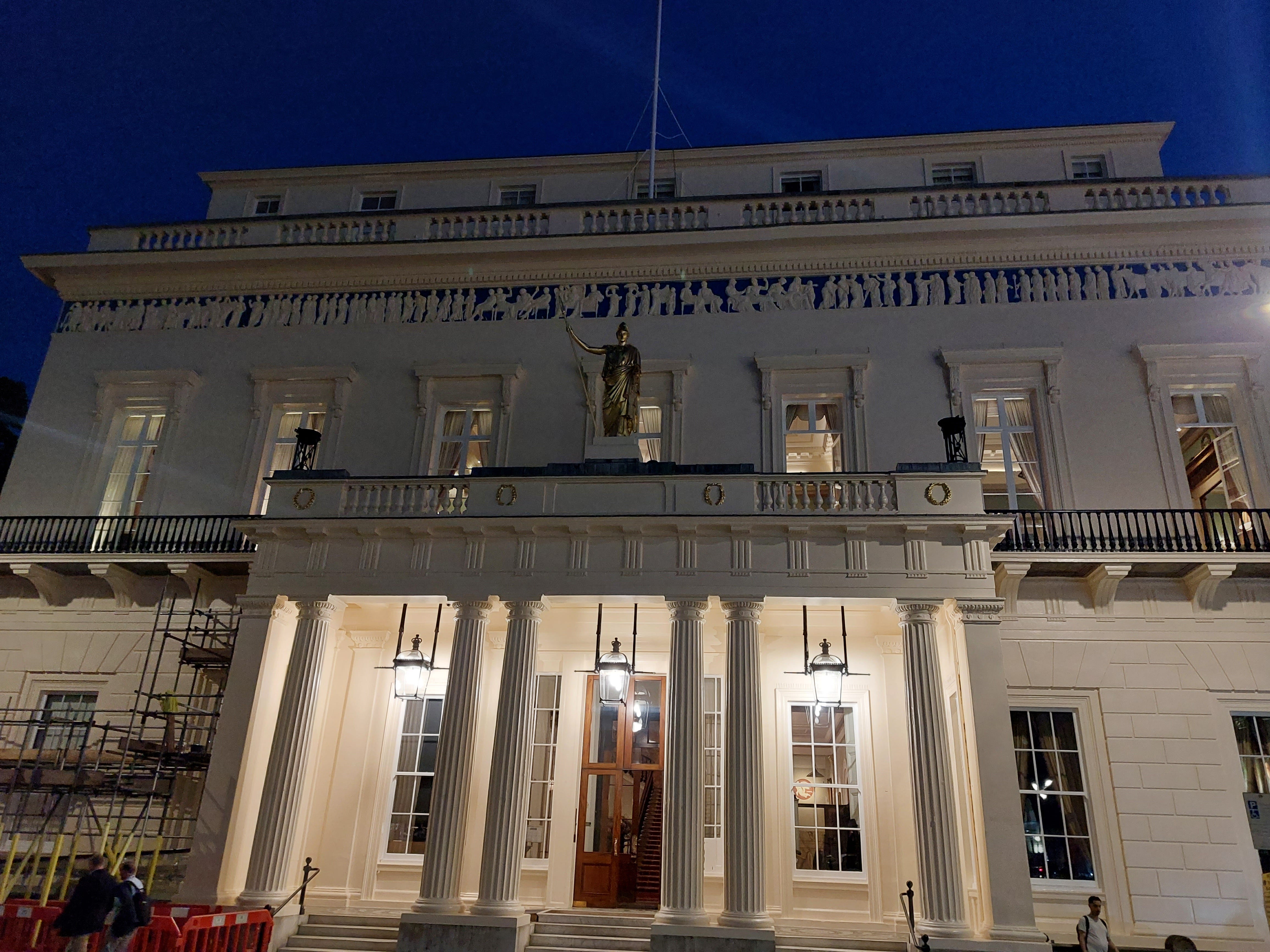
Finally, this day gave me my first little taste of the posh London club scene, as I got invited to a mixer that fortunately began an hour earlier than my evening dinner. It would turn out not to be the last posh London club invite I got that week. As I floated about at these things, sipping champagne and meeting quirky characters and handing out the occasional business card, it dawned on me that perhaps I’ve spent my life being a bit of a closeted socialite. I couldn’t sustain that pace day in and day out, but for the occasional week of fantasy roleplaying, I can play the part better than I thought.
Back to the meat of the week: With Douthat’s morning speech, I was impressed that though it was pitched positively, it didn’t feel like a variation on the prosperity gospel either. Last time, I was reflecting that conferences like this have the feeling of handing you a checklist on How to Save the West, etc. But Douthat is one of those analysts who really understands the tragic vision, something that came through movingly in a recent podcast he recorded that week in the city with Rod Dreher. Dreher’s work has taken on an increasingly doom-laden tone as he’s watched various edifices in his personal life crumble, and Douthat found a moment in their conversation to observe gently that perhaps Dreher had spent much of his career assuming the Right Things would happen to the Right People, only to discover this wasn’t necessarily so.
That depth of insight gives Douthat’s positive vision a weight that others lack. On one hand, his ARC speech proposed optimistically that the Christian faith offers resilience and permanence, and with it what one might call a culturally evolutionary edge as so many permanent goods are washed out on the tide of technological progress. On the other hand, he wasn’t sanguine about the shape of the future in which that faith will be tested: a future in which digital goods are substituted for tangible ones, where disconnection becomes our default way of life, and where human labor is increasingly seen as obsolete.
I also thought this speech deftly drew together all the themes of the conference in one place: our civilizational moment, the social fabric, the tech revolution, and the mundane nuts and bolts of a functional society. I may not have stuck around to hear the talks on free enterprise, energy policy and so on, but Douthat in a way was reminding me why those speakers were there. People need light by which to read the great books, after all. And, of course, air conditioning. “What will save Europe from a long slide into a dark night of barbarism? Air conditioning. What will enable us to think great thoughts and dare greatly and build great things? Obviously, air conditioning.”