

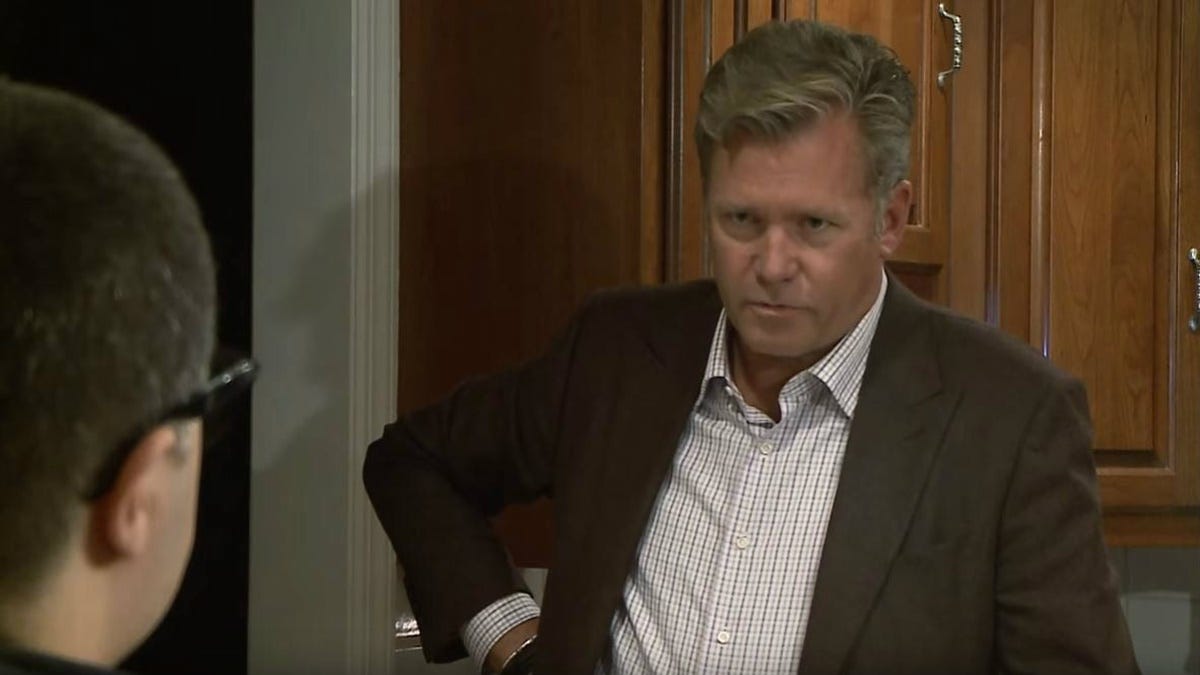
Twenty years ago this November, a small house in Murphy, Texas was surrounded by a television crew and a SWAT team. The officers were on camera. The cameramen were trying as hard as possible to stay out of each other’s line of sight, because cameras generally aren’t allowed on private property without permission of the owner, and this owner certainly hadn’t given permission. But then, the argument went, he’d forfeited his rights in that department when he decided to sexually chat up what he thought was a 13-year-old boy.
The way the script was supposed to go at that point is that the man would agree to meet the boy, the sting house would be all wired up for his arrival, and once the adult decoy lured him in, the trap would be sprung. Cameras would record everything, his chat logs would be humiliatingly read back to him, and then just as he thought he was free to leave, he would find himself in handcuffs. The formula had worked scores of times before. Cops loved it as a way to catch the baddest bad guys dead to rights, America loved it as reality TV, and Chris Hansen—the host whose debonair interrogation style became one of the Internet’s most recognizable memes—loved it as all of the above. Everyone won. But that day in November, local prosecuting attorney Bill Conradt had gone off script. He hadn’t come to the show. So the show came to him. And when he put a gun to his head and pulled the trigger, everyone lost.
The days of primetime television are long gone, but the mythos of Chris Hansen and To Catch a Predator has lived on. The full story of that fateful November day would become an Esquire feature titled “Tonight on Dateline NBC, This Man Will Die.” Now the feature has spawned a movie, Primetime, which seems to have instantly found its target audience: zoomers. The movie only bears a loose resemblance to the facts, and Robert Pattinson’s wildly unhinged interpretation of Hansen bears no resemblance to the man himself. But for Gen Z, the meme’s the thing.
This is not going to be a movie review, because there’s just not much to say about a 2-hour meme disguised as a movie. Whatever Deep Questions it thinks it’s exploring about the corrupting spectacle of televised true crime are ironically lost in its own non-stop meta-gawking. Naturally, Hansen himself wasn’t consulted. But he’s never been a man to pass up a marketing opportunity, and so in amongst the movie’s other previews, viewers are getting his 30-second pitch for his digital age reincarnation, a streaming network where he uploads new sting episodes to this day. The formula is much the same, but legally speaking, the ship is being run tighter than ever. Even the old show had a high conviction rate (according to one intensely dedicated fan, 88.36%), but with lessons learned from the Murphy debacle, police are now not just assisting but driving the operations, including the chatroom encounters. And in 2026, there are no network censors to bleep out the most rancid bits of said encounters when Hansen reads them out to his hapless marks. Like and subscribe!
In fact, quite a few people still do like and subscribe. You could dismiss them all as sickos, but then you’d have to argue large swathes of early noughties normie America were all sickos too. Which, I suppose, is the point of the movie. But it wasn’t just the populist masses who loved the show. It was the mainstream media establishment too. It was Oprah, Jimmy Kimmel, Jon Stewart. It was Conan O’Brien spoofing it for his Emmys-hosting walk-on, which would have paired awkwardly with movie Chris Hansen’s seething that he used to be an Emmy-winning reporter, but now he can’t get no respect. In reality, once upon a time, everyone loved Chris Hansen.
Many a think piece has been written on the strange intersection of cultural streams that begat To Catch a Predator: the rise of the savagely voyeuristic reality show, the young Internet morphing too fast for parents to keep up, the unified post-9/11 hawkish mood. In a time when ordinary Americans were scrambling for a sense of order and control against elusive evil, Hansen offered tangible reassurance that at least some really bad guys somewhere were getting nailed. At the same time, he was giving parents the cold shock that someone posing as a 13-year-old could speak fluent pornographic chatroom slang, and real live predators wouldn’t bat an eye, because it was so common. But meanwhile, who were those real-life 13-year-olds looking up to? And whose fault was that? In 2006, Joe Scarborough could wrap up a Very Serious interview with Hansen one moment, then turn around and pivot to the latest scoop on Britney’s second rehab stint. “Oops, she left it again!”
All the same, Hansen was foresighted to focus on the evils lurking in those chatrooms, and his cause to bring parents this knowledge was noble. The movie never shows any of his educational interactions with parents or teens, because that would concede that the real-life Hansen actually did some public good. By reducing him to a walking meme, it avoids truly confronting the difficult questions at the heart of the phenomenon: Can the medium and the notoriety of reality TV still corrupt a very disciplined man who set out to effectively punish predators and help families, and mostly got what he wanted? And what, at the end of the day, does a society actually do with these men beyond giving them justice? How do we answer the questions Chris Hansen could never answer, the “Help me understand” with which he ended every interrogation? Have we lost the categories to do so, or the grammar?
Some of these predators will walk into their interrogations with a brazenness that matches their screen personae. Some will try to fast-talk their way out of the situation with a transparent BS story, others are outright mouthy or defiant. One episode of the old show features a very disturbingly unruffled young man, whose logs graphically plot out his night with a presumed 14-year-old boy. He tries to claim he was just coming over to have friendly mentoring hangout time. “I know you’ve heard that 20 billion times,” he says, to which Hansen replies without skipping a beat, “20 billion and one, now that you’re saying it to me.” When Hansen eventually reveals himself, the young man coolly says, “I know.”
Another predator pauses in the doorway and tries to get a female decoy to repeat after him that she’s 19. She giggles and reminds him that she said 14. “Rachel,” he finally says in a playful but testy voice, “Can you read between the lines?”
A middle-aged man, a police lieutenant who knows his rights, just sits there smirking and robotically repeating that he won’t answer any questions until he can speak to an attorney. The effect is like the Unman in C. S. Lewis’s Space Trilogy—the demon-possessed professor who in one sequence keeps repeating the protagonist’s name over and over: “Ransom, Ransom, Ransom…”
But others at least give an appearance of shame. They breathe hard and fast. They hang their heads and cry. “Why did you do it?” “ ‘Cuz I’m a sick son of a bitch.” “What do you think should happen to you?” “Go to jail.” Many are married and think, with agony, of their wives. Sometimes, of their young teenage children.
There is no respecting of persons in these sad tableaux. The pudgy loser who can’t tie his shoes gets the same punishment as the community pillar who swaggers in with a freshly ironed Oxford shirt. The plumber and the salesman and the doctor and the rabbi, all go into the dark. Sometimes they recognize Hansen the moment he makes his Angel-of-Death entry. Others mistake him for a cop, or in one pathetic gentleman’s case, a therapist.
That last gentleman features in David Osit’s documentary Predators, a far superior watch to Primetime, which mixes archival footage with new interviews. “It’s not my job to rehabilitate ‘em,” one tough-bitten prosecutor growls. “I have absolutely no compassion for them.” But even he softens a little while playing back some of this guy’s tearful post-arrest sit-down with a female cop. “I don’t deserve any remorse,” the guilty man says fumblingly, presumably meaning he doesn’t deserve sympathy. The interrogator talks to him with a rough-hewn compassion. Both have Southern accents you could cut with a knife. “You’re gonna live through this,” she says, patting his arm. “No, I’m not.” The prosecutor concedes that there’s some potential here. Maybe, with time and rehab, this man could reemerge as some kind of productive citizen.
Of course, tears are one thing, but actual rehabilitation is another. Hansen’s most Internet-infamous victim is a predatory conman named Lorne Armstrong. I do not recommend googling the “lore” around Mr. Armstrong, but the most understated summation is that the man is his own worst enemy. Besides sex predation, other line items on his resume include offering contractor work, then scamming people into paying him much more than it’s worth. He served some time after the sting but has since managed to get himself re-catfished multiple times by the show’s fans. His initial teary reaction has launched a thousand memes and become fodder for Hansen’s merch line. Products include mugs, magnets, pillows, and clothing mostly adorned with the slogan “Have a Seat,” some including Hansen’s face, but the other main offering is a smattering of gear featuring Armstrong mid-blubber. I don’t insist that the wretched man deserves sympathy. At the same time, I don’t feel eager to know the individual who would spend $27 plus shipping to wear Mr. Armstrong’s blubbering face on a T-shirt. I likewise have a lowered opinion of the man selling it.
The Predators documentary follows not just Hansen but his copycats, YouTubers working up their own low-rent sting operations. Hansen scorns them as “doing this for clicks and profit,” while his work is “for a greater purpose.” One imitator who calls himself Skeet begs to differ. Hansen monetizes. He monetizes. Hansen entertains. He entertains. Where’s the daylight between them, really?
Every perp in Hansen’s new show gets a nickname — “Desperate Dave,” “Slapping Sam,” “Daddy Daughter Donnie.” One is christened “Dashin’ Dustin” for the way he desperately bolts out the door after noticing a camera. He’s been lured by a woman posing as a mother who wants to pimp out her own daughter. Of course his escape attempt is comically abortive, and he is immediately hauled back to the kitchen in cuffs for his humiliation ritual. There’s some defensiveness, some rewriting of the history, but Dustin knows it’s over.
What makes Dustin’s case distinctively tragic is that he is caught deep in the Bible Belt, where many men on both sides of the law have some connection to the Church. His family is well-known and loved in the community. A building is named after his father. After the arrest, Hansen discovers the chief deputy utterly crestfallen because he’d gotten close to Dustin doing men’s ministry work. Dustin had an old possession charge but seemed to be on a path to getting his life in order. Hansen lingers perhaps a beat too long on the pain of this revelation. In another post-mortem conversation, the sheriff expresses sympathy for his deputy and keeps repeating how “precious” Dustin’s family is. Then, in an unforced way, this man of the law takes the conversation to a spiritual register. “Satan is on the attack. And he doesn’t choose. He’ll go after anybody. Doesn’t matter who you are.” Hansen listens respectfully, but the dialogue is now clearly above his paygrade.
This, I submit, is the missing piece—in the show, in the fandom, in the spinoff products, even in the Predators documentary, which does its best to approach the topic intelligently but ultimately can’t progress beyond the language of therapy culture. This is the one area where Primetime does try to do something more interesting, albeit in a vague, cheap horror-movie way that doesn’t lead anywhere illuminating. As the storm clouds gather, a progressively psychotic movie Hansen starts to hallucinate monstrous faces in the dark. He narrates an extended flashback sequence to his reportage on child abduction in India, ominously speaking of the “ancient, evil force” he discovered there. This is how he frames his work to himself, not as grubby, bottom-feeding exploitainment but as a righteous, world-cleansing crusade against the forces of darkness. The ambitious young decoy he’s training listens with fascinated terror, trying to understand what he’s gotten into. (This character is based on the real-life decoy who was the last person to speak with Bill Conradt, moments before the gun went off. In the Predators documentary, he says that if you offered him ten million to do the episode again, he wouldn’t take it.)
There’s no evidence that Hansen is hiding pedophilic tendencies of his own, but the movie does get fictionalized mileage out of the fact that a real tabloid caught him cheating on his wife. Karma! The hunter hunted! As is typical, timelines are shifted for maximum dramatic effect, and it’s heavily suggested that movie Hansen doubles the intensity of his crusade to expiate his own sexual guilt. I’m not sure the evidence points that way for the real Hansen, for whom the phrase “tortured soul” doesn’t exactly come to mind. You can see how smoothly he reacts to a question about it and be the judge. In another interview about the show where someone raises the idea of a slippery slope starting with pornography, Hansen somewhat agrees but also pauses to emphasize that he’s “not trying to be Pollyanna or overly onerous about what adults should look at,” quickly directing the conversation towards child pornography. Against ancient primal evil, Hansen sets modern liberal values.
Predators follows Skeet, the copycat I mentioned earlier, on one of his shoestring stings. Their target, lured by a female decoy nicknamed “T Coy” who doesn’t quite pass as the teenage girl she’s impersonating, becomes hysterical. The officer who’s supposed to show up is running late. Panic rises as the team goes into a huddle to figure out how to prevent their own Murphy moment. Skeet tries to calm the man down. In tears, the guy says that he has a son, that he was just starting to try to put his life back together. He would “take suggestions” for “programs.” He wants to take “the right steps” and go “forwards, not backwards.” “I’m sure we could pull a few strings…” Skeet says awkwardly, saying nothing just to say something. But “Anyway, I’m…Skeet Hansen, and…you’ve just been Skeeted.”
As the man continues to hide his face, someone on the documentary team separately approaches with a release form, explaining he doesn’t have to sign it if he doesn’t want to. He doesn’t want to. “Well,” Skeet remarks after it’s all over, “That was…some heavy shit.” But hey, maybe they saved a life today. Or two lives. “A child’s life and a predator’s life, look at that.”
As T Coy the Decoy plays the episode back, she’s disinclined to be kind. She’s an abuse survivor herself. As far as she’s concerned, this guy “just got two hours of free therapy with y’all.”
Still, “I am human, even though I can be a bitch.” After a moment, she says, “I don’t know why I feel bad for him. I guess ‘cuz it’s sad.”